
“Longing produces modes of both belonging and “being long,” or persisting over time. Yet, this is more than desire, for desire is a form of belief in the referential object that the subject feels s/he lacks and that would make him or her whole (and insofar as this referential object is often posited in terms of a lost object, desire is ‘historiographical,’ a way of writing that object into the present). Erotics, on the other hand, traffics less in belief than in encounter, less in damaged wholes than in intersections of body parts, less in loss than in novel possibility….”
–Elizabeth Freeman, Time Binds

A little while ago, i was very lucky to attend a panel discussion of Gayatri Spivak’s massively influential essay “Can the Subaltern Speak?” at CUNY’s Center for the Humanities. Spivak has often described her critical and pedagogical work as a task of, “re-arranging desires.” She uses the one-liner, “Plain prose cheats” as a counter-argument to charges that her prose is too difficult to follow. A major text of deconstruction, Derrida’s Of Grammatology, found its way into English through her translation, and it was her choice to use the word trace–an outline, a track, a remnant, a footprint, a spore–as a way of marking a number of concepts from Derrida that can’t be fixed with a single word: “…Derrida suggests that what opens the possibility of thought is not merely the question of being, but also the never-annulled difference from ‘the completely other’. Such is the strange ‘being’ of the sign: half of it always ‘not there’ and the other half always ‘not that’. The structure of the sign is determined by the trace or track of that other which is forever absent” (Spivak’s “Translator’s Preface”).

Plain prose cheats. i came across this puzzle early in grad school, and it seemed infinitely more honest to me than some of the other slogans my fellow budding Marxists were latching onto. Sous les pavés, la plage (beneath the paving stones, the beach), for instance, seemed well-intentioned, but naive. The fantasy of a pastoral return to some kind of harnessed true nature just didn’t quite persuade me. i think the High Line park in Manhattan is a more viable model.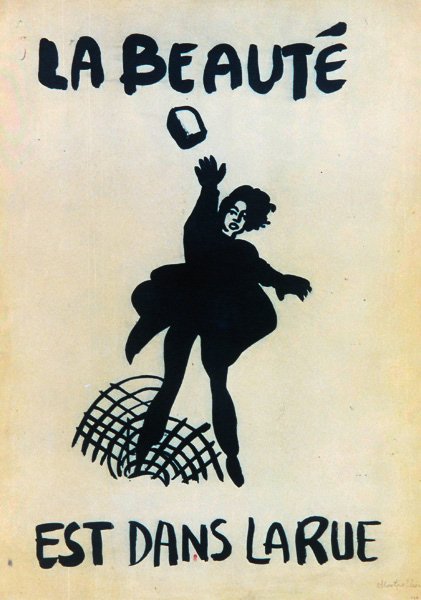
i found that other great Situationist axiom, La beauté est dans la rue (the beauty is in the street), to be more appealing. My boyfriend at the time had a crinkly photocopy of the image of the girl in the street throwing a brick taped to his wall, and for years it was the first thing i saw when i opened my eyes in the morning. Ah, Gainesville. The Gainesville where you didn’t have to begin at the beginning every single time to have these conversations because it was ongoing, i miss you. My first tattoo (i only have three) was of the Japanese term for ‘trace’ inside my left wrist. i was still studying Japanese at the time, and thinking a lot about translation, and the kanji for trace was on the cover of a book i was reading. Now i look like just another girl with a Chinese symbol on her body that maybe means fate, maybe destiny, she can’t remember and can’t read it. Pretty cheezy, i know, but i would never have it removed. i treasure it as the mark of that initial passion i had for theory and academia.

Plain prose cheats. Here is Spivak: “[W]hen I’m pushed these days with the old criticism – ‘Oh! Spivak is too hard to understand!’ – I laugh, and I say okay. I will give you, just for your sake, a monosyllabic sentence, and you’ll see that you can’t rest with it. My monosyllabic sentence is: We know plain prose cheats.” When i saw Spivak, the event reminded me of why this phrase strikes me as such a necessary warning. i would stay on auto-pilot for at least another year after seeing her, but, very slowly, i began to shift gears. Judith Butler was on the panel, and each speaker gave a brief, engaging description of how Spivak’s essay had formed her or his work. i had almost not gone. Jonas was sick and i had to take him, coughing, to the sitter, if i wanted to go. With a heart heavy with mother-guilt, i went. When Spivak spoke, she told this story. This is a very long quote, forgive me:
“My grandmother, Raseswari Debi, had two sisters – Saileswari and Bhubaneshwari. The youngest one killed herself at 17. It is her story I tell in “Can the Subaltern Speak?” In order to show, that whereas the British Indian reform of sati is much celebrated, when a young, single girl attempted to write resistance in her very body, she could not be read.
If only I could occupy with desire, that singular inscribed body. I have tried to understand how she felt as she waited for her periods to begin, so she could disprove what she knew would be the conclusion drawn from her hanged body – illicit pregnancy.
My modest reputation rests on two items – the introduction to Derrida and the commentary on Bhubaneswari Bhaduri’s suicide. I am following that track, still. Why did I not mention my relationship to her, when I wrote of her? I wanted to see what would happen if she didn’t have that certificate of authenticity which would reflect more on the people’s approval of me, than on her.
In my reading this morning, I cannot tell how it was she who opened up for me that line from the Mahabharata – a description of Queen Draupadi, dressed in her single cloth, stained with menstrual blood, dragged into the royal court. But I can say that it is perhaps from this single woman, a girl of 17 who engendered my intellectual trajectory, that I get my sense of singularity.
I repeat in difference, these singular women who are mothers in many different ways, who teach me that reproductive heteronormativity is simply one case among many – like a stopped clock giving the correct time twice a day, rather than a norm that we persistently legitimize by reversal.
The entire epic of the Mahabharata is about this insult to Queen Draupadi, who had five husbands. And in the beginning of the Mahabharata, because it was an oral formulaic epic and each bard had to know the whole story – the entire story is given in the form of a young boy telling it to the blind king.
And in that story, again and again, we hear that all of this disaster happened because a woman was brought into public while she was menstruating; while she was in her feminine nature – stridharma.
She was a queen. The queens, when they menstruated, were taken to a lower chamber and they wore only one piece of cloth until the menstruation was over; then they took their bath – healing bath, I suppose – because they were unclean.
That’s the whole story behind Bhubanehswari also, that I’m asking you to remember. She used this menstrual blood as a way to inscribe her message and was not heard. But anyway, when the five husbands in the epic are playing dice in the main court – they keep losing and finally they wager her.
And so, when they wagered her and they lost, she was dragged up from that chamber downstairs. So the queen comes into the open court wearing nothing but that one white cloth, smeared with menstrual blood. This is the thing that led to the fight.
Now, as to how a feminist reads this, that’s something else. This is not a presentation of a feminist reading of the Mahabharata, but I’m just saying that because my grandmother’s sister dragged herself into the open court of death menstruating, only earned me opprobrium from people who read quickly, and said – Spivak refuses voice to subaltern resistance.
And I see women every day saying – the subaltern is speaking because I am, and so on. And I say to myself – my mother was wrong. She had said – you are using her name? I had said – ma, no one will pay any attention to her. And I was right.
So the queen is dragged up. She asks the oldest member of the court, who also has a marriage story – am I a piece of property that can be wagered? And the oldest member of the court, Bhishma, is not able to answer her.
This is not a bit from the Mahabharata that’s given much popularity. If you have seen Peter Brooks’ version, you certainly have not noticed this. But there are female versions of the epics, StriMahabharata, which are very different and in the best-known of them, the entire epic ends, not with the brothers climbing the hill to heaven, but Draupadi laughing in the devastated field of war, somewhere in the empty camps. Draupadi’s laughter ends the women’s epic.
Now, the bard describes Draupadi as nathavati anathavat. Generally, this is translated as – someone with husbands, as if an orphan. Natha actually means lord. I translate it differently. And as I said, I am the object of opprobrium from the traditionalists and the racists and the horrible guys, as well as the resenters of theory, the activists; as well as the folks who are in the traditional camp, faulted for being too European.
Nathavati anathavat: Lorded, and yet, as if not lorded. In my reading, each time the woman menstruates, lording has misfired in the suspension of reproductive heteronormativity. And I believe that’s why, again and again and again, in the opening conversation that is the entire story, what is told is – she is in her feminine nature, in herstridharma, suspended.
A suicide at age 17, and a disgrace in the family, made me understand how the message in the ancient text was transactional. She became my allegory of reading of a powerful woman-moment in my past. And in fact, that way of reading is what allows us to be responsible to our students. I hope I have not been too theoretical for you, but I gave you my alibis before I began.”
Really, you should read “Can the Subaltern Speak?” to fully grasp this story, but i hope this anecdote also works on its own.

 noVacancy