
Mothers, don’t let your daughters grow up watching Gone With the Wind unless you’re prepared to offer some very complicated voice over narratives about–and this is just a start–slavery, dialectics, unrealistic expectations, entitlement, anorexia, staying, S/M, withholding, leaving, prostitution, and the South. As someone who is curious about the formative power of cultural texts, i am interested in the books and films i was drawn to as a young person. If i was ever going to write one of those ‘everything i ever needed to know i learned from’ treatises, Gone With the Wind would be my source. To be sure, i was also given some of these lessons in a much more potent form by my surrounders, but this film seems to have gotten all of the best of the worst just about right. My conversations with Mom about it went something like this:
Me: Does Ashley love Scarlett, too?
Mom: “i don’t know.”
Me: Then why does he kiss her?
Mom: “Because he’s spineless.”
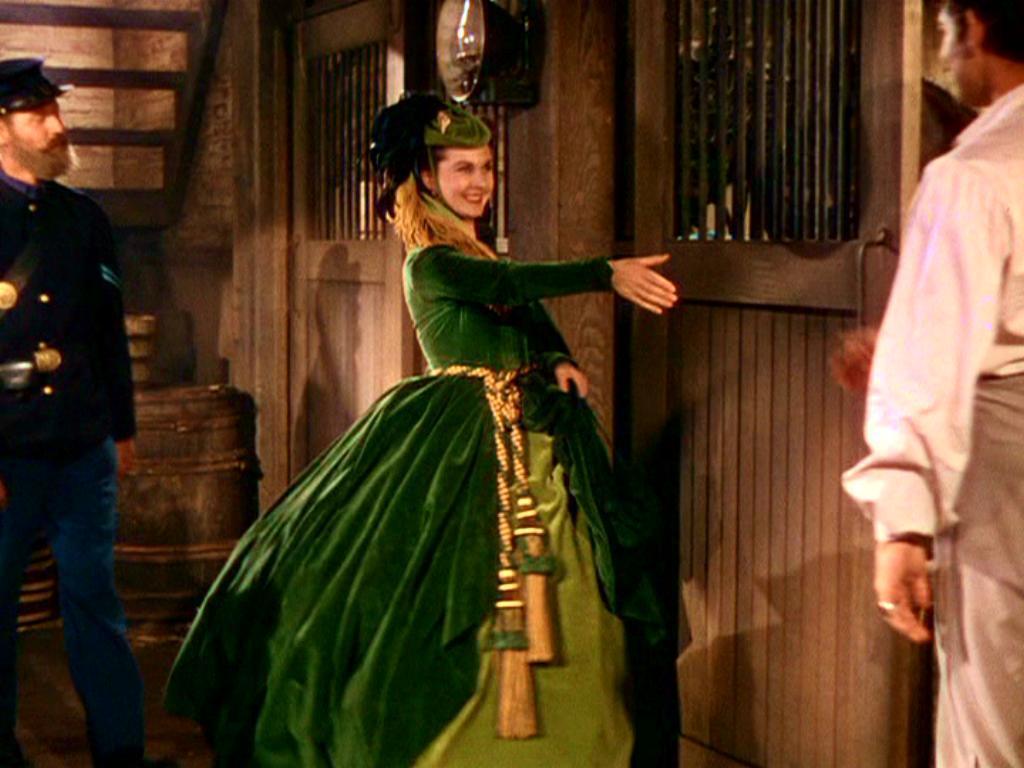
Mom doesn’t mince words, and she’s usually right, and yes, Ashley is a total weenie, but something like, “Because sometimes we’re attracted to people we don’t really like,” would have been helpful. Or even, “Why is Scarlett so attached to Ashley? He’s self-absorbed and he’s never really there for her and his mother/whore complex is out of control. Is it possible that she really loves Rhett, who is actually crazy about her?” Even better, “What do you think about the fact that Mammy is a slave in the first half of the movie, but after the war she is supposedly free?” And, very importantly: “You understand that even though Scarlett has the best dresses she’s not exactly, like, a role model, right?” Because, no–i was not yet versed in the manipulative devices granted to the antihero. Scarlett’s refrain, “I can’t think about that right now. If I do, I’ll go crazy. I’ll think about that tomorrow,” got me through more than one shit day when i was a kid. After all of the other jerks ran off to war, Scarlett was the one who got the fields planted and made sure everyone had something to eat. Scarlett shot the yankee when he tried to steal her mother’s jewels. Scarlett came up with the idea to fashion the iconic green dress with the chartreuse underskirt and the drapery cord belt out of her mother’s velvet curtains so that she could trick Rhett into thinking she wasn’t totally desperate: “I’m going to Atlanta for that three hundred dollars, and I’ve got to go looking like a queen.” Mammy has to make it, of course, but we’re supposed to gloss that detail.
Nonetheless, i hardly grew up under civil war. When i first began writing this blog, someone very close to me read it and responded, rather angrily, that i seemed to think that readers with more ramshackle childhoods than his own might be able to engage the blog better than he could. i wasn’t surprised by his response; i know that i have a habit of romanticizing the things that hurt because…because why? Because it makes me feel like i’m in control? Because it changes the narrative? Because i like to feel bad? No, no one actually enjoys feeling bad, right? Right? Right, but it’s not everyone who actually wants to feel, either. And sometimes, quite often actually, extreme discomfort feels really good (read: familiar) to me; but, surely there has to be another way to go about experiencing this? My body, my narcolepsy usually gets the upper hand in this conflict. Stress levels go up, i start really pushing myself, my body says uh-uh and gives me some kind of internal rufie. When i’m at work and this happens, i will often go and sink my hands into large buckets of ice that are meant to be chilling wine. Slowly, i come to, because i hate being cold.

 noVacancy