
My Mom’s cousin, “Aunt Babsie,” has a few mantras that my Mom has taken on over the years. One of them is, “Water is our friend.” Fair enough. Kind of funny at the right moment. The main one is, “Nothing is ever lost,” which my 3 year old really likes. Me: “Jonas, where are your shoes, honey? i can’t find them anywhere.” Jonas: “That’s okay, Mommy. Nanny says, ‘Nothing is ever lost’.” Sometimes it’s cute. Other times, at 8 in the morning when Jonas is in danger of getting locked out of his Catholic preschool, for instance, it just makes me cranky. Negligent New Age platitude useless not helpful arrgggh.
Last week, when Juan from the MTA NYC Transit Lost Property Unit called to let me know that a bag i left on a subway over a month ago was waiting for me at the 34th St. lost and found, Aunt Babsie’s phrase immediately came to mind. i yelped and thanked the guy on the other end of the phone over and over. The bag itself is a bleach-stained, tattered, beloved, gross, kind of blue Diner tote with a faded white whale decal on the side. Inside i had lost my wallet, a bright green Comme des Garcons pouch–a borderline fetish object for me. The wallet held about $100 cash and all of my cards: my ID, my social security card, museum memberships. Also in the bag were notebooks i am using for my dissertation; a clear plastic Muji pencil case containing a fat black eraser; two mechanical pencils and my favorite ballpoint pen–also from Muji; a zip drive on which i store all of my important work; some postcards i had just purchased at the Frick; an endorsed paycheck; my house keys. Basically all of the things that make my life function. When the bag came back to me, all of these items–excepting the cash and the bag from the Frick–were inside.
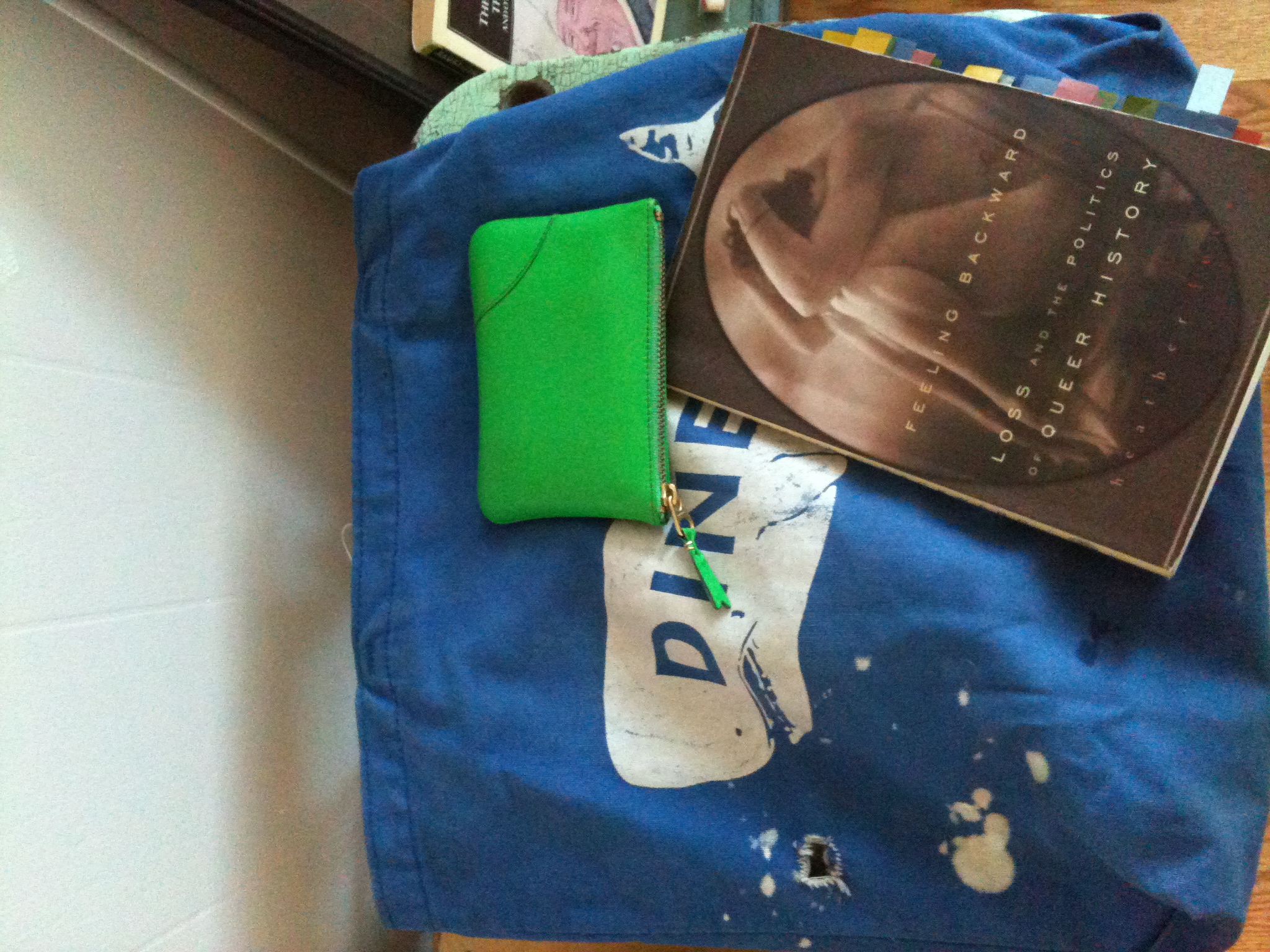
Also in the bag, and also now back in my possession, was a copy of Heather Love’s Feeling Backward: Loss and the Politics of Queer History. Feeling Backward is an academic book in heavy rotation for a dissertation chapter i am writing. My weathered copy is filled, from start to finish, with little tabs and handwritten notes. It is a book that i use. i was shocked to have lost it. Somehow i have never misplaced a favorite book. As i am both prone to losing things and in possession of many, many books, this was yet another reminder, in a year filled with so much loss that it was beginning to feel like a self-defense mechanism, that some things are worth keeping.
Of all the books to have suggested this lesson, Love’s book is keenly appropriate. The epigraph to her introduction is from Roland Barthes: “Who will write the history of tears?” Love’s introduction goes on to suggest: “Sometimes it seems better to move on–to let, as Marx wrote, the dead bury the dead. But it is the damaging aspects of the past that tend to stay with us, and the desire to forget may itself be a symptom of haunting. The dead can bury the dead all day long and still not be done” (1). A connoisseur of abandonment, Love argues that attending to painful, useless, and even embarrassing attachments is also a kind of action and a potentially necessary component of agency. Hers is an affective critique of the teleology of progress and of the alleged necessity of letting go.
Surprisingly, i think Aunt Babsie might be right about this one. Perhaps nothing is ever lost, although the shape it returns to us in is occasionally unrecognizable from the one it took when it was lost. In practice, actually deciding not to lose things is much harder than it seems. Most of us are taught to replace a feeling as soon as it is taken from us, or when we decide to lose it, because absence is so uncomfortable and…confusing. Sometimes holding onto something or someone who escapes us over and over can even teach us how to hold all over again, because a connoisseur doesn’t trade; she learns.
 noVacancy