You can never give/ the finger to the blind.

IMG_9366.JPG

“The unpampered ear does more. Once when I was in Michigan for a term, and didn’t have a record player, someone in Shaman Drum put on Lloyd Cole and the Commotions, and I had to stay there browsing unobtrusively for the next forty minutes, feeling like a pervert. That’s music starved, that’s not bad repro.”
–Michael Hofmann, Paris Review

Last Tuesday, mid-day, I was walking down and around 5th Avenue and 12th Street with a cardboard box full of LED Christmas lights and golden, glittery, spray-painted pine cones. I was mid-job. We were decorating a semi-famous actress’s apartment for her holiday party. On my way back from retrieving a few extra things from the parking garage, rain began to fall. My arms were full and I couldn’t reach for my umbrella, so I sidled up between a few strangers with more coverage than they really needed and fell into step with a couple of them as the light changed.
IMG_9368.JPG
Two men directly behind me, one vaguely professorial and the other eager and overly agreeable in that grad student sort of way, both probably attached to the New School which was right up the street, were talking shop. My ears perked up at a few derisive comments about multiple dissertations “on” Alvin Toffler’s Future Shock. I moved closer as the professorial one cited Ben Lerner’s new novel, 10:04, as a positive example of something the dissertations were missing. He referred to the review of 10:04 in Bookforum that he’d just read?written? (I wasn’t close enough to hear) in order to make an argument about the argument Lerner was making about the future. I had the novel in my tote bag. I’d been dragging out the last few pages, not wanting to finish, for the last week. I opened my mouth to argue with him about his characterization of the novel, and then I looked into my box and remembered where I was and who I seemed to be: some sort of local crafter, wet in the rain, somehow implicated by this box of decorative objects. I realized I didn’t know these people and would probably seem a little nuts if I did interject and, as for the immediate future, I had completely forgotten to buy suction cups with little hooks on them to attach the actress’s wreath to a large mirror in a subtle but sturdy way.
/home/wpcom/public_html/wp-content/blogs.dir/7d1/23639144/files/2014/12/img_9369.jpg
When I was an undergrad, my favorite professor’s most controversial pedagogical strategy was to keep the false binary between public and private under erasure at all times in his dealings with us. In a class called “Black Britain” there were 2 people who were Black in the American way. One of them was always late. My professor, who was Black in the British way, unsuccessfully tried to provoke this student into punctuality by reminding him that “Hey motherfucker,” classes at the University of Florida did not run on “colored time.” One night at a bar he met my handsome blue-eyed boyfriend, and the next time I saw him he said,”I guess that makes your life easier when you go home for Thanksgiving.” The classes were terrifying and electric. For better or worse, he incited more future academics than anyone I’ve ever studied with. I think he might be responsible for that Gainesville flow that probably still pops up at academic conferences: aggressive, funny, and, most of all, in that late-90’s critical theory way, provocative. The aforementioned binary was under erasure in order to disabuse us of our understandings of desire as something that occurs, “in a vacuum.” I can’t speak for everyone, but I am certain that he permanently transformed my understanding of and relationship to want. I began to understand desire as always already embroiled in relations of economy. /home/wpcom/public_html/wp-content/blogs.dir/7d1/23639144/files/2014/12/img_9374.jpg
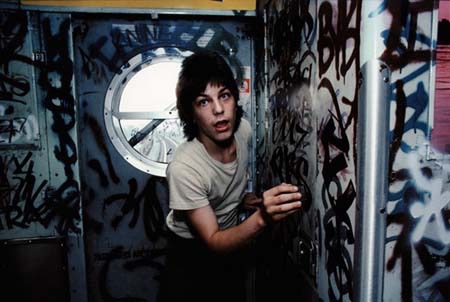
I don’t know about other cities, but there is something that happens every once in a while on the subway in New York when one train passes another. Their coming together feels magnetic as the cars swoosh into a brief clickety-clack rhythm like the sound of a “real” camera. Every time for me it is diamond dust. It is a reel of actual film spooled out me-sized in some sort of Purple Rose of Cairo meets Andy Warhol New York minute. I spy on the passengers in this doppelgänging car and feel the lines between window and mirror blur–momentarily happy again for this city’s enchantments. Always cinematic. Always already a repetition of what I saw or read of this place before I moved here. A future shock where the fact that everything is always already translation does not dilute experience.
/home/wpcom/public_html/wp-content/blogs.dir/7d1/23639144/files/2014/12/img_9377.jpg
When I was in grad school, because utopia–that elusive bastard–was still nowhere, and because we wanted to join the ranks of those who are clever enough to get paid to at least try to save the world, we made critical theory the action of trying to find the places where the ideas we most valued in theoretical texts were made possible in fiction. In 10:04, almost every time Ben Lerner launches into a new anecdote, I feel myself rolling my eyes back into my head just as I would have in grad school when some insufferable classmate felt the need to go on at length about his or her misunderstanding of that week’s text. Instead, I catch myself riveted, eyes wide, as he rips into an example that illustrates his complete comprehension–not only of a concept but also of how to illustrate the concept. Not in reference to so and so’s novel or short story, but through his own writing. I’m not convinced that that is actually a difference that matters, but I am quite sure that the novel “matters” very much. This is darstellung of the sort I had always tried to find. In it, reification, once a death trap, becomes a beautiful, funny source of endless potential.


/home/wpcom/public_html/wp-content/blogs.dir/7d1/23639144/files/2014/12/img_9367.jpg

We sit together drunk, like our fathers used to be.

The sky was breaking, and I felt a little less numb

than the alcoholic devotedly spooning

pate from a tub; than the divorcee’s station wagon

with its dog-haired sheepskin dogseat;

or the birds barking in the trees to greet the day . . .

“Up in the Air”  — Michael Hofmann

i’m not in the habit of giving poems to people, but yesterday i passed along the same Michael Hofmann poem for the second time in a year. i read an okay amount of poetry–i think i can comfortably say i read more of it than most Americans, (i’m guessing that anyone who’s actually read a whole poem this year can say the same), and his are the ones i carry around.  i’d been up and down Manhattan Avenue twice already. Once to buy water balloons, once for coffee, and now for coffee again as i walked my friend back to the train. We’ve known each other for almost 20 years as adults. We had just left a Memorial Day barbeque. We met working in a restaurant. We were were both ex-cheerleaders and current English majors in the process of “turning” weird. Jonas was soaked in exploded water balloons and basically asleep in my arms and we–both of us (ex?) Floridians–stepped slowly, comfortably warmed by the kind of heat that seems impossible to remember until you’re back trying to move through it, while talking quickly, down Manhattan. She is looking for poems for a project she is in the middle of, and i made a few suggestions before i got to Michael Hofmann.

There is a kind of queerness that doesn’t always wear itself obviously. i am starting to understand that it has something to do with having had a queer childhood. i mean queer both in its current and in its antiquated sense. Children of single parents, of jailbirds, of foreigners, of teenagers, of iconoclastic parents, of families that moved around incessantly, of queers. Of being poor, of being an easy crier, of having had to act like it’s okay to have everything fall apart when you’ve already had a bad day because that same dick at your lunch table made fun of you for being flat. Again. It’s been going on for so long that anyone else would have grown boobs by now. And the absurdity of being bullied for physically looking like a child when you aren’t supposed to anymore while you have had to perform emotional adulthood since long before this jerk had pubic hair is just too difficult to explain. Of being allowed to be quiet and just sit around and read whatever you want, and watch whatever you want, and eat whatever you can find, and listen to what you like over and over, because no one is home. Of having to act like the past-life regression happening upstairs is interesting. Of having had parents switch gender roles, or both perform the same one, or of never having normative models for either. For pretending so hard to be normal that no one would ever guess what your world was “really” like–whatever that means. Some people who are raised loosely fill in those holes as adults, because they finally can. Because they have to know what they missed. Others find being broken-in more familiar, and can’t ever quite adjust to the story of what we are supposed to do at different points along the line–but continue to try. i suppose there are endless variations here, but i am immensely curious about what other people find  comfortable. For some of us comfort actually seems like perversion–picking at the strings is sometimes the only relief.  For others of us regularity feels like a welcome challenge.

i don’t know much about Michael Hofmann’s childhood, other than what is suggested by his Dad’s book, Luck, but i have spent some time with his poems, many of which are either about his father or about fucking. There is a queerness to them that seems to me apiece of what i am describing here. The willful risk for the erotic. The unwillingness to designate the poems as a place where any juxtaposition might be too much. A way of existing i find attractive even though i was raised to understand it as repulsive. The complications of nature and the inescapable weather. Mexico. Men. Music. Dad. Drugs. Kids. Cheating. Hart Crane. Starting again. Lynyrd Skynyrd.  Drinking. Class. The biting observations of a stranger as he becomes a familiar. Silencing word choice. The South. Europe. Gainesville. London.

Beer drunk, sitting across from him one night at the Salty Dog Saloon in Gainesville, i said something about not being able to fathom having had a famous novelist as a father, (as he had), or of being the child of someone who did similar work to my own, when my own father is an electrician who spent most of his working life climbing poles. Your job as an academic is not so different, he said. Plugging things into holes.

This is the poem i recommended to my friend, who is interested in hotel rooms.  It is from Corona, Corona (1993):

“Schonlaternengasse”

Better never than late like the modern concrete
firetrap firegaps spacing the Austrian baroque, risi pisi;
like the morgenstern lamp’s flex leaking plastic links of gold,
leaving the cutglass nightlight good enough to drink;
like the same tulip reproduction twice in our hapless room,
where the twelve lines of a spider plant die without offshoot:
your period, which we both half-hoped wouldn’t come.

Here is another, from Poetry (June 2008):

“For Adam”

In that aftertime
I wasn’t writing. I never wrote,
I didn’t know what the aftertime was for.
I felt little, collected nothing.
I talked to myself, but it was boring.


Even if your cheap career depended on it.

i prefer, to a calculated fault, the thing that is supposedly not the better thing. i feel sorry for assholes, Christmas trees, and panhandlers. Commercials make me cry. i enjoy other people’s smoke, can’t let go of taped-up shoes, rig my sunglasses with paper clips, and cherish articles of clothing that have earned their holes.  i prefer Manhattan Ave to Bedford, school to home, eating at the bar to a table, humor to comfort. i encourage unfinished business and jeans. Uncorrected proofs.  Marx. Laundromats. Trannies. Grey hair. Snacks. Jittery diesels. Dirty stories. Rain. Skipping breakfast. Old people. Adolescents. Houseplants. i buy boiled eggs. i think Stockholm syndrome is kind of romantic. i know this is a list of cliches. Sometimes i don’t care.

One of my Florida apartments was in a carriage house in the backyard of one of the Medievalists at my University. Once, just after an actually devastating hurricane, i had to go into the big house for something.  For some reason i was without a chaperone. Maybe the back door was open and i’d wandered in, desperate to find someone? Regardless, i found myself alone, walking through a beautiful but quite lived-in house. It was the sort of place i might usually go for, but then i hit the scary room. The walls were lined with ningyo, Japanese dolls, and they were unkempt, almost rotten, and in such a large quantity that the space disturbed me. i imagine myself walking backwards out of the room and scampering back into my own private attic. This is not the kind of preservation i collect.

In Be Here to Love Me (2004), there is an interview with Townes Van Zandt’s son that has haunted me for years. Looking clueless and sweet, the son mentions that they only ever bought groceries at convenience stores.  When i saw the film, i was fresh out of leaving someone i really, really hadn’t wanted to leave. My ex only ever shopped at the convenience store up the street. Beer and crackers, mostly.  Watching the kid mention this detail casually but bringing it up because he knew it was a big deal kind of…scared me.  A tiny thing that hints at walls of disturbance. i thought about him walking up the sidewalk to the store, a gesture that seemed gigantically immediate, driven, and short term, and i couldn’t stop crying for a while.

“Mostly Middle,” Michael Hofmann’s review of a new collection of Elizabeth Bishop’s poetry  in the London Review of Books, 8 September 2011, locates her skill as a poet who only hints at the crazy: “It is in rare, late poems that Bishop permits herself not a long look so much as a brief glance at the worst: ‘A yesterday I find almost impossible to lift’ (‘Five Flights Up’) or in ‘One Art’ (a poem so stifled in its compressed clamour I’ve never cared for it): ‘It’s evident/the art of losing’s not too hard to master/though it may look like (Write it!) like disaster.’ ” Compressed clamour. The art of losing. Yesss.  i’m not arguing for indiscriminate abandonment here. i’m looking for places where people found a way to do it constructively and carefully because it had to be done.

Cheesy, great Voices and Visions (1988) clip:

http://www.youtube.com/watch?v=0gMVffgkpfQ