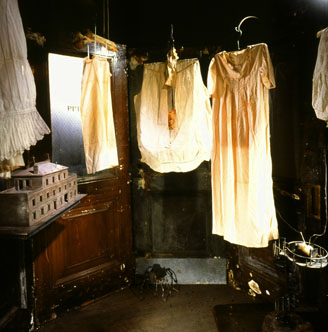
Louise Bourgeois, Cell VII, 1998
Shortly after returning from Japan, i took a job answering the phones at a hair salon booking appointments, making confirmation calls, and pushing product–basically working for the discount and the free services. My boyfriend pulled a similar shift at a thrift store around the corner. i would go over and sit with him sometimes when i got off, or wade through the aisles, modeling ridiculous clothes i never intended to buy. i have kept a handmade mauve, twill, A-line skirt i bought one day on his employee discount. It became a staple of my wardrobe, and some recognition of him honestly flashes up every time i’ve ever touched it. When i was pregnant and imagined my body to be permanently transformed, i sold most of my vintage clothes. The twill skirt was in a drop-off bag for Beacon’s Closet. At the last second, i snagged it out. Yes, i was starting a new life, but i wasn’t willing to let go of every symbol of my densely layered history. The skirt and its ability to conjure the early days of long, skinny Todd sitting quietly behind the counter (probably wearing a pair of brown polyester trousers and a short-sleeved button-down shirt; let’s imagine Dog Man Star is soft in the background) was not ready for consignment. It was material: the physical part that stands in for and triggers a whole pack of memories, but also a symbol of the possibility of a story.

The line is: “I’m just doing this for the material.” It’s an excuse for having to do, or even preferring to do, the thing that hurts. Poets, scriptwriters, actors, rock and rollers–do they need the material for the work, or do they do this work because the process of translation makes the material more liveable? i have a pile of journals that stretch to the ceiling full of what my therapist calls data that i always planned on Rapunzelling into stories, but if i don’t ever get around to it, what do all of those, err…lessons, become? What’s the difference between a memory and material? One reaches for representation, the other becomes a decent story over staff meal, at best? Likewise, what does it matter if i’ve got 500 books stacked in my office and i’ve read everything by Judith Butler, and most of Foucault and Jameson and Barthes if i never write my dissertation? Once again, it’s the burden of representation–i haven’t done the work until i can connect my turn on the argument to a larger conversation, even if writing a dissertation that maybe five people will read is, in many ways, a huge leap of faith.
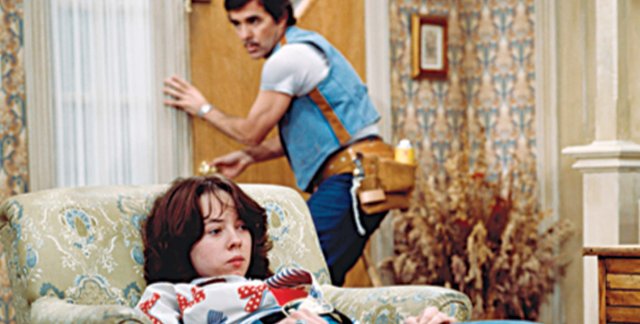
i’ve been reading High On Arrival, Mackenzie Phillips’s memoir. It is a fretful thing. i pause and i’ve read a hundred pages, but i have to put it away for days before i can pick it back up. Nonetheless, these memories of her father — (John Phillips of the Mamas and the Papas) never showing up, insistently not hiding anything from her (“Not now, honey. Daddy’s shooting up”), forgetting her again and again at the airport or in an apartment while he’s off scoring drugs with Keith Richards — also connect to a life of collateral damage and prestige. Trying to be like Daddy, she falls into a near lifetime of drug addiction and ultimately into years of a drug-fueled sexual relationship with her Dad. Her attempt to give form to a childhood that was at once insanely glamorous and an object lesson in abuse and abandonment is, perhaps, a semi-successful example of someone using her material. i’m not at all interested in whether it achieves catharsis or redemption, but in her narrative stretch to represent complex desires that chip away at the canon of normativity. Somehow, impossibly, even after having experienced a terror of a life, she is also able to convey the strange beauty of growing up, in many ways, off the grid. There are many anecdotes of fantastic decadence and uninhibited pleasure, but this is also the narrative–not of a successful iconoclast–but of a child made to work with this model who didn’t choose it, coming out on the other side of Stockholm syndrome. It is a story about passionate attachment–attachments chosen over death and complete isolation, and the reality that the way these options present themselves can create complex, almost unreadable lives: “It was like being reared by a beast. A gorilla. A narcissist, a Svengali, a megalomaniac. A charming, endearing rogue” (190). Her oscillations between attachment and identification to her father and the tangled history she supplies are bundled into this account of shitty, hard witnessing. Somehow, she used her material, and made something out this repetitive relationship to abandonment.
Even if your cards were thrown in tarot rather than the royal court, a path to the straight and narrow might still present itself–this is the hard part. Sometimes the road is clearly marked and stacked deep in rewards, but for some of us it’s like trying to ride your bike on the highway–terrifying, impossible, awkward, wrong. All of the traffic signs are unreadable, and you keep getting lost. Whether you can’t or don’t want to is an impossible distinction, but it can be comforting to realize that you won’t. Your roots might push you up and through the path, instead of down it, but there is a kind of flowering in that stasis that the drivers will always miss.
 noVacancy