

My middle name is Sunshine. That’s what my parents decided, and it’s funny after a few drinks. It doesn’t quite match my temperament; that is part of the joke. i can’t say that it hasn’t always, but once i started learning that i could say no to things, my insistence on that word (that word that no one thinks she wants to hear) shortened my candidacy for beacon of light-hood.
In a further flattening of affect, a couple of years ago i was diagnosed with narcolepsy, a central nervous system disorder that produces the sudden, uncontrollable onset of sleep. There is no explanation for why people “get” it, although it seems to have something to do with heredity and something to do with a shortage of a brain protein called hypocretin that may regulate when and how we sleep. Other symptoms include, “features of dreaming that occur while awake,” and cataplexy–attacks of muscle paralysis triggered by strong emotions. i exhibit both. This means that i have to constantly consider my behavior before and while doing almost everything. Getting in an argument while walking down the street is basically impossible–my knees buckle and my legs just give out. Telling a joke is hard. Giving someone a basic complement, if i really mean it, makes me tremble. Allowing myself to get frustrated when doing things like, say, waiting tables is also problematic. My hands start to shake, plates begin to clang, and i have to take a deep breath and stabilize myself on the edge of a table or the bar to keep from falling on diners. i get sleepiest after i eat, which means that eating alone at a restaurant, sitting at the bar–one of my favorite things to do, can also be tricky. The subway is a crapshoot. In general, i have had to become less of a hothead, because when i try to lose my cool, my body doesn’t cooperate. For someone who had never been very interested in controlling herself, this has forced extensive modifications of my nature.
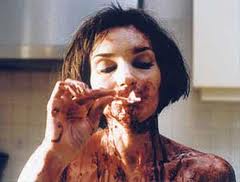
Claire Denis, Trouble Every Day, 2001
Research that produces articles with titles like, “Brain Protein Tied to Sleep and Feeding also Involved in Bodily Sensations,” suggests that hypocretin also sways how we eat and how we respond to pain. This study reports: “Perl and his colleagues were intrigued by the observation that hypocretin nerve fibers terminate in a spinal cord region involved in sensations about pain-causing events…It may be that a decrease of the protein ‘helps people sleep and minimizes attention to minor inputs. Conversely, an increase helps a person to continue to do an essential function like eating even when there are minor inputs from the peripheral nervous system, such as occurs when one sits on a rough edge,’ the neurophysiologist explained.”
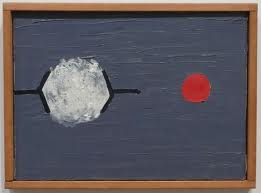
Forrest Bess, Untitled, 1967
 noVacancy