He’s a prophet, he’s a pusher

"I ain't dealin' no more, man."


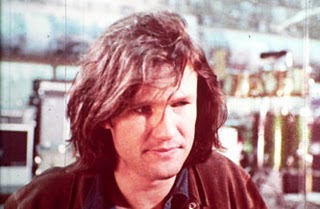
The opening sequence of Bill Norton’s Cisco Pike (1971) follows Kris Kristofferson, the eponymous Cisco, as he ambles through Venice Beach, guitar case in hand.  We see him first as a reflection in a canal, and then as he begins to cross over a little bridge that has been tagged, “The Human Race.” Kristofferson’s song, “Loving Her Was Easier (Than Anything I’ll Ever Do Again)” deceptively softens the opening visuals. He is not on his way to meet a lover, but to a music store to hock his guitar. Although most of L.A. now seems to recognize him as a pusher, Cisco is also a down and out rock and roller. The store owner, improbably played by Roscoe Lee Browne–whose stateliness projects Cisco’s shabbiness into pathetic relief–is delighted to see Cisco. He greets him with an excited smile and an unironic,”Hey brother, it’s been a long time.” Looking at his guitar case, he teases, “Well, what have you brought me here? A little coke from Cuzco?” Cisco winces and tells him, “I ain’t dealing no more, man.” In a complicated sleight of language, Brown corrects him: “You mean you isn’t dealing no more,” and then lists a string of names the guitar evidently performed with: “Cash.  Joplin.  Dylan.  Odetta. A million memories,” imploring Cisco to keep the guitar, he declines the sale.  Cisco roughly packs it up, clearly in a snit. Browne extends his hand, Cisco pauses, smiles, and shakes it, saying, “I’ll see you brother.” Again Browne troubles the race and class parameters of this exchange with a sassy, “Ciao bello.” Browne’s parting words: “Now remember, that distinguished American philosopher Satchel Paige said, ‘Don’t look back, something may be gaining on you’.”  (Paige was a legendary black baseball player also known for his witticisms.) Cisco will shortly be conned into helping the cop who busted him, Officer Leo Holland (Gene Hackman), unload a shit-ton of weed over the course of the weekend.

Coming along at the commencement of the Seventies, the disillusion is strong with this one. Unlike Hunter S. Thompson’s explosion of form in Fear and Loathing, this narrative is not suspicious of its medium–formally it is a straightforward drug heist movie. Much of the drug dialogue is expository and dorky, but the film’s charm is its documentation of a scene and its density of dirty, gorgeous, iconic actors. Gene Hackman, Karen Black, and Harry Dean Stanton round up the cast, along with the bizarre, dazzling Viva, who is billed as a co-star.  Soon after his return to dealing, Cisco stops into a recording studio to get a friend to listen to some new tapes he’s made, and Merna (played by Viva) trolls him up.  Here is their first exchange:

Merna: “You a dealer?” Cisco: “Nope.”  She picks up his little black book and asks, “What’s that?” Cisco answers, “That’s my girlfriend’s.”  Merna: “Well, then. Will you sell me a pound?” C: “Of what?” M: “Anything you’ve got. I’m not choosy.” C: “Yeah, I can do that.” M: “You know, it’s a rather interesting accent that you have. How long did it take you to learn it?” C: “Not long. I majored in shit-kicking. That’s an interesting shape you got there. You’re kinda pregnant, ain’t ya?” M: “No, I’m just holding it for somebody for a couple more months. If you won’t take a check? Did I ask you if you’d take a check?” C: “No. Gotta do cash.” M: “Well, then. If you won’t, I guess we’ll just have to go to my house. Is that all right with you?” C: “You silver-tongued devil. You talked me right into it.”
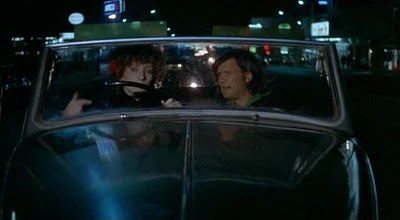
Cisco and Merna on their way to the Source.

Cisco, who lives with his girlfriend Sue (Karen Black), tags along with Viva. They pick up her girlfriend, Lynn (Joy Bang), from the Source–Father Yod’s legendary restaurant. Back at her house they have a threesome, and if you look closely, you can indeed catch Viva’s little pregnant belly. Later in the film they meet up at the Troubadour and Waylon Jennings happens to be playing. Cisco’s guitar case will only carry dope for most of the movie. He makes his deals from a phone booth, huge stack of quarters piled up, as if he were gunning for the high score on Pac-Man. Later in the film, Cisco’s old bandmate Jesse (H.D. Stanton) shows up and they head over to Merna’s–a huge, Grey Gardens-esque crumbling L.A. mansion. As they ascend the stairs, Cisco asks, “You got anything to drink?” Merna responds, “What do you think we are, rich?” A structure of feeling, to be sure. Hard to say why it compels me so.
We Don’t Do Time

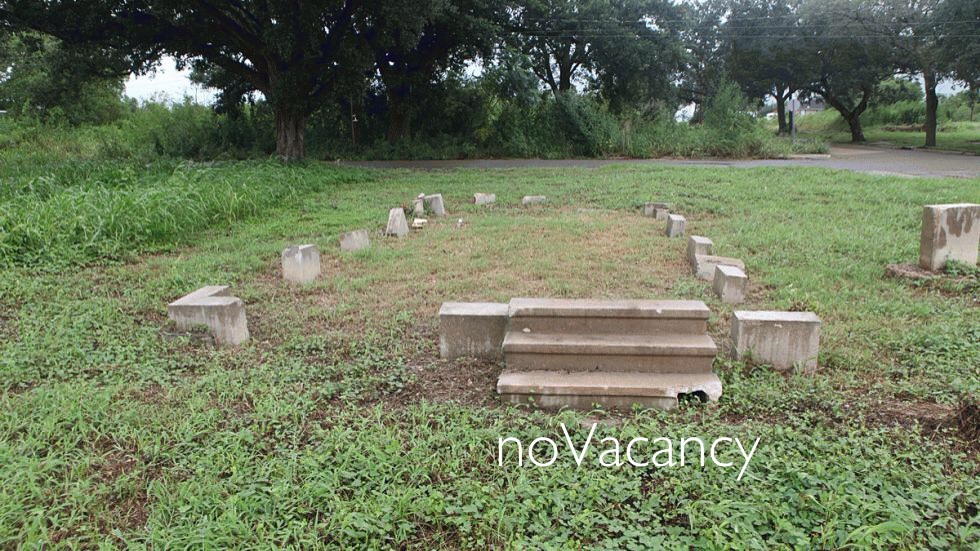
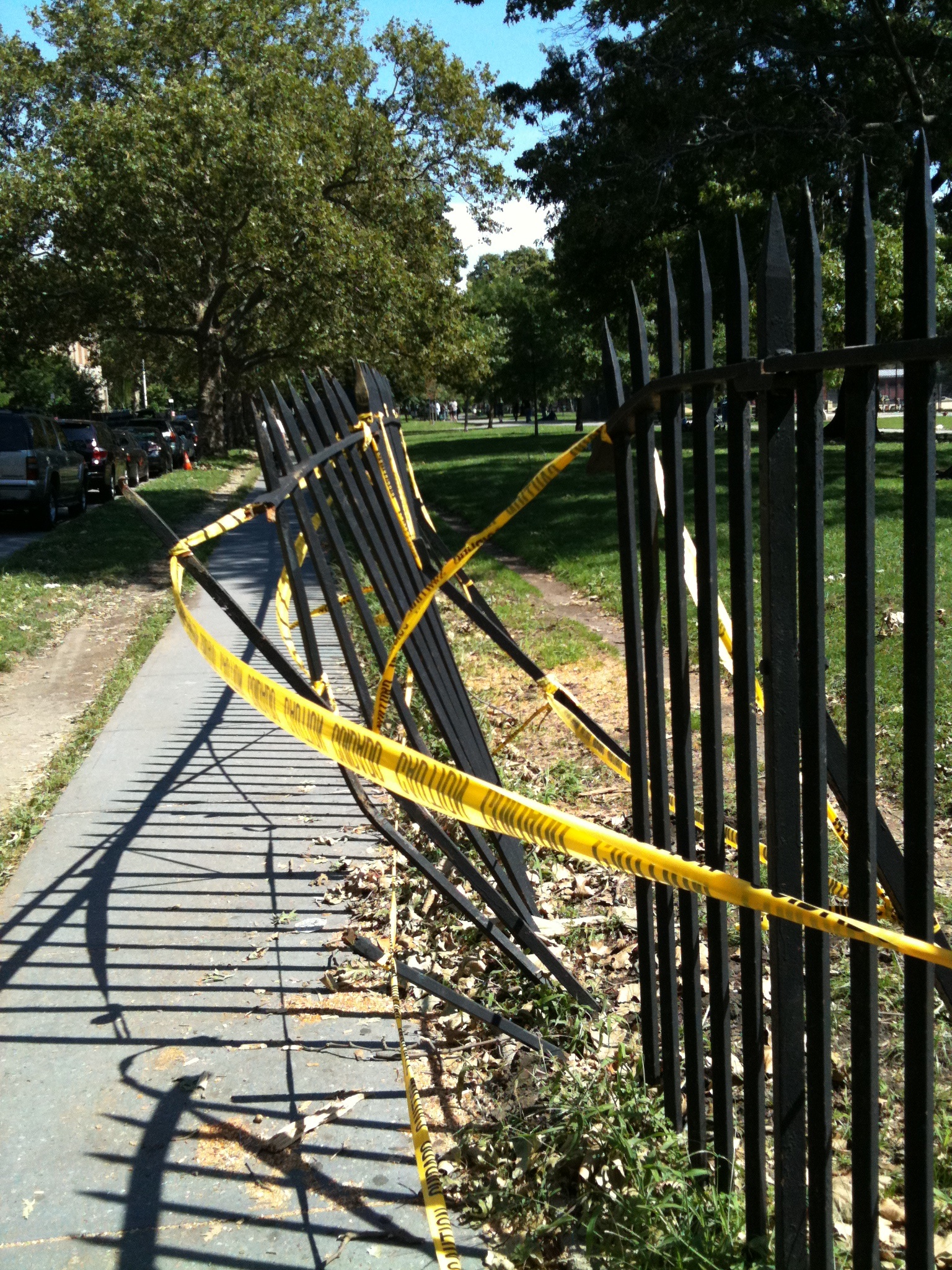
i snapped this picture in McCarren Park last weekend. A tree was the real culprit behind the damage, but i couldn’t help thinking of one of my favorite literary connoisseurs of abandonment, Cecilia from The Virgin Suicides.

“As soon as she had permission, Cecilia made for the stairs. She kept her face to the floor, moving in her personal oblivion, her sunflower eyes fixed on the predicament of her life we would never understand.  She climbed the steps to the kitchen, closed the door behind her, and proceeded through the upstairs hallway.  We could hear her feet right above us. Halfway up the staircase to the second floor her steps made no more noise, but it was only thirty seconds later that we heard the wet sound of her body falling onto the fence that ran alongside the house. First came the sound of wind, a rushing we decided later must have been caused by her wedding dress filling with air. This was brief. A human body falls fast. The main thing was just that: the fact of a person taking on completely physical properties, falling at the speed of a rock….The wind sound huffed, once, and then the moist thud jolted us, the sound of a watermelon breaking open, and for that moment everyone remained still and composed, as though listening to an orchestra, heads tilted to allow the ears to work and no belief coming in yet. Then Mrs. Lisbon, as though alone, said, “Oh my God.”

Stockholm Syndrome

“When I was growing up, all the women in my house were using needles. I have always had a fascination with the needle, the magic power of the needle. The needle is used to repair the damage. It’s a claim to forgiveness.”  Louise Bourgeois

Before my son was a week old, I put him in a car seat and we rode in a cab all the way from Williamsburg to the Guggenheim. My Mom was leaving the next day to go back to California, and I wanted her to see the Louise Bourgeois exhibit.  He cried for most of the time we were there, and the entire way back. I never made it to the top of the rotunda, but the trip wasn’t really about me seeing the art.  I needed my Mom to see the work, and I wanted Jonas to be there, even if it meant nothing but discomfort to him. While I was pregnant, I had gone to see a documentary film about Bourgeois: The Spider, the Mistress and the Tangerine.  I was taken by the ways that both her ambivalent relationship to family and motherhood and the vibrancy of her anger drove her artistic productivity.  In one interview, Robert Storr suggests, “She generates energy, and she generates psychological energy. She’s also a vampire. She sucks up psychological energy.” She explains of herself, “It’s not the emotions themselves, but it is the intensity—the emotions are much too much for me to handle, and that is why I transfer them, I transfer the energy, into sculpture. This applies to everything I do.” During the portion of the film that discusses her steel and bronze spider sculptures, Laurie Anderson’s song “O Superman,” right around its 6 minute mark, pipes in.  Bourgeois has just told us, “The spider is the mother.” We see one of the gigantic spiders, and the song’s unmistakable pulses begin, followed by Anderson’s hauntingly distorted voice with its flat demand: “So hold me Mom, in your long arms.”  I immediately began to cry.  I still have my Mom’s Laurie Anderson albums, and I vividly remembered her playing Big Science during my childhood.  This song wasn’t really about the Superman I knew, but it did suggest to me that my Mom was a kind of imperfect, preferable superhero(ine).

The needle, thread, and spiders (but no webs—perhaps they don’t last long enough).  Repair as artistic method. This is familiar to readers of queer theory, especially of Eve Sedgwick and her suggestion for “reparative,” rather than “paranoid,” readings.  The idea that the material of one’s life might be mended through creative production is less combative than vampirism and less sure of itself than merely paranoid critical readings. Even in those first days, I wanted my own parenting to attempt a kind of renovation, not only of my childhood and my relationship to my family, but also of cultural fantasies I had been taught about parents and parenting.  Showing my Mom the work was a way of saying thank you for the unusual, difficult, queer, invaluable upbringing my parents gave me.  i also wanted to suggest that thinking about attempts to represent these experiences teaches us how else we might behave.

“So hold me, Mom, in your long arms. In your automatic arms. Your electronic arms. Your petrochemical arms. Your military arms. In your electronic arms….”

It’s Just a Jump to the Left

A fantastic selection of Connoisseurs of Abandonment compiled last Fall by the students of AML 4282 (LGBTQ Generations):

Finding Nemo (Kiwi)

Christopher Robin and Winnie the Pooh (Natecia)

David Leavitt’s novel, Lost Language of Cranes (Ashlyn)

Rocky Horror Picture Show (Irene)

The Celluloid Closet (Katie F.)

The Brady Bunch (Sandy)

Janelle Monáe (David)

Leslie Feinberg’s novel, Stone Butch Blues (Jessica)

Gay Days at Disney (Christopher)

Kanye West (Celia)

Francis Burney’s first novel, Evelina (Vicky)

the musical Spring Awakening (Katie C)

experimental filmmaker Su Friedrich (Elizabeth)

Deepa Mehta’s film, Fire (Alexis)

Drag (Alex)

Brent Hartinger’s YA novel, The Geography Club (Jared)

Allen Ginsburg’s Howl (Melia)

Shakespeare’s Twelfth Night (Kayla)

Jennie Livingston’s film, Paris is Burning (Jamie)

Sojourner Truth (Elliott)

Marci Blackman’s Po Man’s Child: a Novel (Mimi)

F. Scott Fitzgerald’s novel, The Great Gatsby (Kayleigh)

Queer Hardcore band, Limp Wrist (Vincent)

James Franco (Alison)

an interactive website about AML 4282 (Elyse)

a film about AML 4282 (Brittany)

We’ll Take the Night.

i do not read Leonard Michaels, who composed some of my favorite paragraphs of narrative, to make myself feel better. Not exactly, anyhow.  i go back to Sylvia, for example, to hear a smart voice make lovely sentences about the difficulty of representing unpredictable connections between desire and productivity: “There was nothing erotic in this picture, and yet we sometimes went from fighting to sex.  No passport was required. There wasn’t even a border. Time was fractured, there was no cause and effect, and one thing didn’t even lead toward another. As in a metaphor, one thing was another. Raging, hating, I wanted to fuck, and she did too.” His passport analogy spatializes the relation, saying: nothing could’ve stopped us and nothing tried. The disabling of causal time confesses an irrational gusto of passions that had no script.  Sylvia admits to the impossibility of knowing precisely what sex is supposed to do, and to the disaster that can ensue when guilt and shame persuade sexual desire to become something of which it is incapable. The eponymous Sylvia of Michaels’s novel kills herself when she is 24 years old. Forty-seven Seconal, a few glasses of bourbon, a hard fall, and she is dead. The novel blends portions from Michaels’s journals with his own fictional retelling of their story. No explanation is offered for why he stuck around for as long as he did. She is, in his telling, intolerable; but Sylvia is not a defense of his inability to save her. It is a compelling, quick read remarkable for its attempt to represent an unliveable series of events. i never get a handle on whether he abandoned her or not. This is, for Michaels, “autobiographical fiction.” i tend to presume that his refusal of the form of straightforward memoir makes his primary concern a good story rather than an airtight defense. She is material, but his use of her seems loving–never the exploitation it very easily could have become. According to his narrative, the night she swallowed the pills he had come to, but never actually got to, ask for a divorce.

Emma Forrest’s new memoir, Your Voice in My Head, obliquely answers a question i recently posed to someone i almost married as i was leaving someone who i had: “Why does leaving also feel good?” He’d fired back: “Connoisseurs of abandonment, trained by our ‘rents.”  i know this is true–his childhood home was even more broken, Southern, and poor than mine was–but i see the tip of a different answer in these snippets from Forrest. Emily Gould, Forrest’s NYT reviewer, assures readers: “She acknowledges that she is privileged to be able to mine her suffering for material.” And, “Writing about an abortion, she admits, ‘I have the luxury to find inspiration in the pain because I am a middle-class girl with a tight-knit family’.” In other words, Forrest’s failures are okay because she has learned a lesson and because she is clever enough to turn this lesson into a book deal.  She also writes against what she describes as a daily battle with the temptation of suicide. Not for nothing is there an endorsement quote from Elizabeth Gilbert, author of Eat, Pray, Love, on the cover of Forrest’s book. What, then, is to be made of less repentant narratives of the desire to bust things up?

If a connoisseur is basically someone with a degree of expertise, then i agree with my ex’s reply.  Perhaps those of us who were made to survive abandonment early on also learned how to depathologize “no.” Forrest’s memoir is basically one long thank you note to everyone who keeps her alive, peppered with scandalous and well-rendered anecdotes. Michaels, on the other hand, seems less interested in the saviors and more dedicated to materializing the story.

i like this “connoisseurs of abandonment” phrase, so i dug around to see who else had used it. Here it is, in a book called Abandoned Women and the Poetic Tradition by Lawrence Lipking: “To catch a whiff of future abandonment at the very moment of passion lends an exquisite sadness to love . . . Byron had learned that secret early . . . A connoisseur of abandonment, he shares it with all his lovers.”  And here, from a 2/27/94 article in the  L.A. Times by Barry Bearak, “On most Saturdays, the organizers drive the streets and creep around the brick corpses.  By now, they are connoisseurs of abandonment, picking out the better buildings the way an expert chef might select fish on the dock.”

The first interpretation does not interest me; the second one does.  We do not inhabit the past, or a love, or a place, simply because it sits vacant. Nor do we build in order to destroy. We choose our new stories carefully, with an eye to how they will taste, or feel, or last. Sometimes we are wrong. The peach is pulpy, the apartment is too loud, the heart is not as strong or soft or smart as we’d hoped. My favorite cover by the Detroit Cobras takes this in stride, explaining: “You can’t miss nothing that you never had.” The art of losing isn’t hard to master, as Elizabeth Bishop suggests. The difficulty is in understanding why the graceful loser always wins.