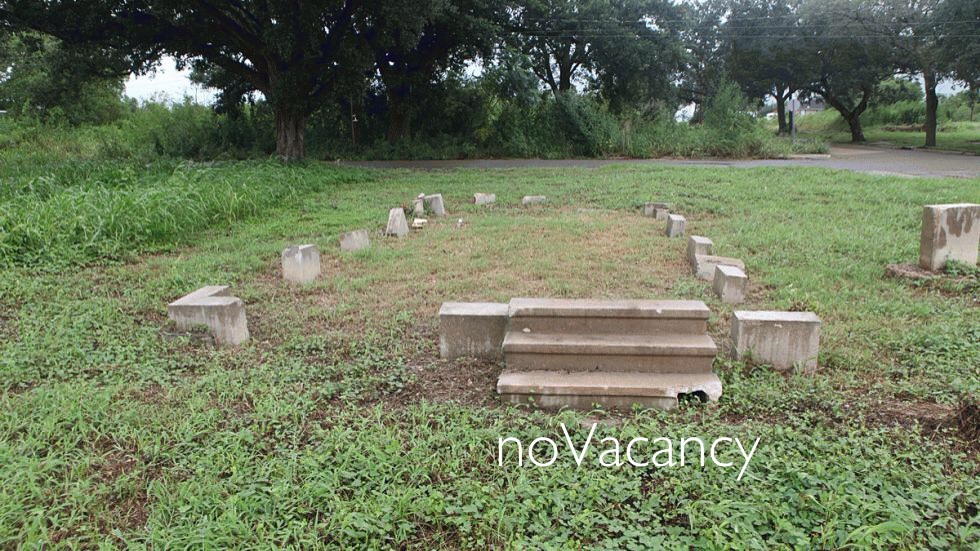
You fixed yourself, you said, “well, nevermind.”

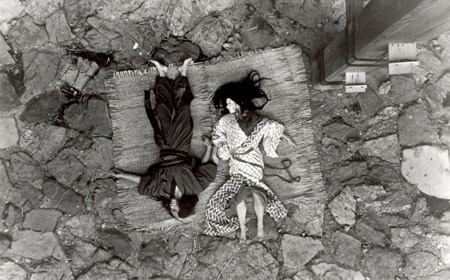
“Real things in the darkness seem no realer than dreams.”–Genji Monogatari

On my 20th birthday, i got engaged.  My boyfriend was 6 years older than me, and we had been dating for a little more than 2 years–living together for one.  There was a picnic, and a diamond, and then later, a wedding. No one was surprised–except my mother, who hadn’t yet caught on to the fact that the organizing principle of my young adulthood was simply (cheerleader in high school, 4.0 in college, borderline anorexic, part of a couple) to not become her.

Very soon after we were married, my husband and i moved to Japan.  i was studying Japanese for my undergrad, and my school had a (seemingly) very affordable study abroad program.  It was designed, of course, for young, single students. Most students lived with a Japanese host family, but there was also a small dorm on campus, and everyone who didn’t have a host family stayed there. Everyone, of course, except me. We had gone early and rented an apartment. He got a job teaching English and i had a sizeable stipend from the Japanese government.  My hour and a half commute to school–each way–was standard salariman. From our apartment, i walked for about 20 minutes through a part of Osaka called Kyobashi, past crappy bars and tons of love hotels to get to the Keihan line, which ran between Osaka and Kyoto. My school was basically right in the middle between the two cities, but another 20 minute walk or 10 minute bus ride from the train stop. We would find out much later that Kyobashi was basically Osaka’s skid row, but we never had any trouble.

i studied my notecards while i walked. Memorized vocabulary on the train. We  barely had enough money to eat, so we chose whatever would give us the most calories for our yen at the grocery store: sticky white rice with peas, puffy white bread for toast in the morning, daigaku potatoes (deep-fried, candied sweet potatoes), and anman (white, warm sticky buns with sweet adzuki bean paste inside) from the  7-11.  Impossibly, we got skinnier. Osaka was shockingly hot, and humid. His job was miserable and we never saw each other.  Gradually i stopped studying on the train and began looking outside instead, committing to memory the way the city turned into houses turned into green turned back into houses back into city. i went to Fushimi Inari on a school fieldtrip: a temple dedicated to Inari–god of rice and business, guarded by hundreds of fox sculptures and lined with thousands of torii.

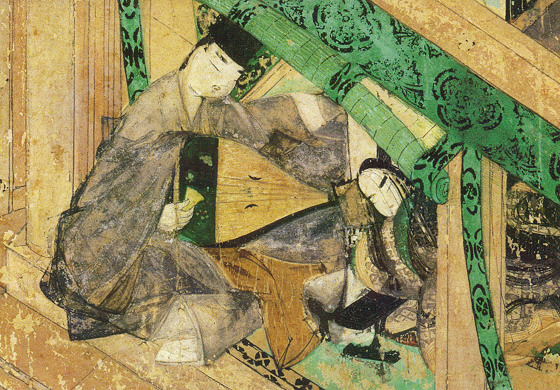
Order melted into disorder became another order. i studied as much, if not more, than ever, but there were no bogus electives like ‘Geography of World Economies’ or ‘A History of Non-Western Art’ to distract me. Just Japanese, but vocab became paragraphs became newspapers. i took a class on Murasaki Shikibu’s very long, very romantic, absurdly beautiful 11th Century novel Genji Monogatari (the Tale of Genji). We read the entire thing. i bought a tiny portable cd player in denden-town and walked and walked.

My grammar teacher and i often found ourselves waiting for the same bus in the morning. We got in the habit of falling to the back of the line to smoke cigarettes and finish our coffee. He’d recently completed his PhD and returned to Japan from a long hiatus in an exotic country studying a dead language, and this was his first year at the University. He was originally from Tokyo. i gave up trying to understand this with my halting Japanese and we began again in English–cracking jokes about our class, talking about where we’d come from, admitting to our new marriages, and arguing about whether Genji was cheezy or not. In class, i would force myself to track the light in the bamboo groves just outside the window, because there was something about the way he held the chalk, and how quickly he moved, and how i jumped when he called on me–“Mindy-san?”–that was unravelling me in a way i had no intention of really, actually letting happen.
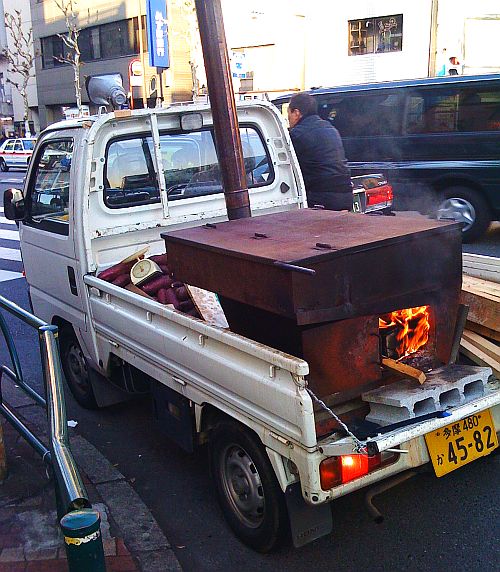
In 1950, my grandfather, who had survived WW2, found himself testing a wooden plane off the coast of San Diego.  The plane went down. He was survived by my grandmother, my mother, and her little sister.  A few months later, my grandmother boarded a freighter with her young children and sailed to Japan to serve as a missionary, so, there’s that. She told me the stories she remembered over and over. My Mom did the same. i felt like i kind of had to get there, but i had always imagined myself as a studied observer, not so much as a participant.  Now, i wanted complete immersion. October came to Japan and mornings and afternoons–suddenly lit by ruby and garnet and tangerine maple leaves, seemed like the middle of the night to me.  i read, in the Genji: “Autumn is no time to lay alone.” Anorexia was chased off by eel and ramen and sake and sweet potato venders driving their tiny trucks down backstreets yelling, “YAKI-IMO!!!”
The bus gave way to momiji (maple leaf) viewings–just sitting outside at temples, drinking beer and staring at autumn all lit by stone lanterns. Temples gave way to sushi bars and eel restaurants and sitting on the edge of the Kamo River knowing what came next and enjoying those last minutes of pretending that it didn’t.

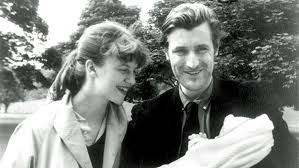
‘With my gipsy ancestress and my weird luck’

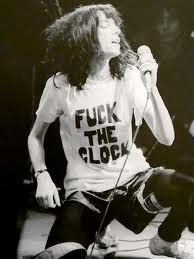
Sylvia Plath: famous (lady) poet; famous suicide (“Dying is an art. Like everything else, i do it exceptionally well. I do it so it feels like hell“); famous Daddy complex (“Every woman adores a fascist“); famous mother (“Love set you going like a fat gold watch“); famous committed to a psychiatric ward (“I didn’t want any flowers. I only wanted to lie with my hands turned up and be utterly empty“).  But also “Lady Lazarus,” famous zombie–famous patient of electric shock therapy (“There ought, i thought, to be a ritual for being born twice–patched, retreaded, and approved for  the road“).  “Daddy,” the poem, has been in my head for days–“You do not do, you do not do“–it begins, and its turns are strange, angry, dedicated, alchemy.

You do not do, you do not do
Any more, black shoe
In which I have lived like a foot
For thirty years, poor and white,
Barely daring to breathe or Achoo.

Daddy, I have had to kill you.
You died before I had time--
Marble-heavy, a bag full of God,
Ghastly statue with one gray toe
Big as a Frisco seal...

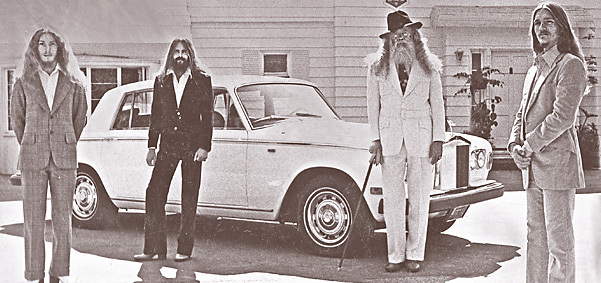
i tried to read her novel, the Bell Jar, a thinly-veiled memoir of stepping off the line one summer while she was in college, my freshman year of high school.  i had to give up. Patterns in rugs and tiles began giving me the spins. i thought i was losing my mind. i read Jane Eyre instead, which, if i hadn’t already had one (unlikely), helped put my own daddy complex into play.  i picked it back up in college, impossible to find what had so disturbed me on my first try. Shortly after i started working at my current job, my dear friend and former boss from the Feminist Bookstore emailed me: “You are working at a restaurant named “Father”? Yes, indeed. In the owner of the restaurant’s mother tongue, the name of the restaurant means father.  The owner and the executive chef were both new fathers that year, and the name was meant to have marked that connection. That “Daddy”–(TWO Daddies, even)–might become a formidable organizing principal was not lost on me.  That it actually became a seriously disorganizing principle was also no surprise. There were early promises of a utopian, almost communal work environment. Father Yod’s The Source was hoped to be a model, but it didn’t quite turn out that way.

In my early bookselling days, one of my favorite jobs was to clean the shelves. i would pick a shelf. Remove all of its books, wipe the shelf down, and carefully replace each title. i would read the back of each one before doing so, and slowly, in this way, i familiarized myself with every title in the store. We had a small, ‘womyn’s only’ erotica section, and the titles here were often the best: The Ethical Slut, Off Our Backs, On Our Backs, and Doing it for Daddy.  Doing it for Daddy, by Pat, later Patrick, Califia was less about actual fathers and more about leather daddies and master/slave fantasies.  As i’d been reading Butler and little bits of Hegel for some time, lordship and bondage was already on the table.  i often played back a quote from Hegel i’d found in Butler: “…a freedom still enmeshed in servitude,” as a way of thinking through my life in the food service industry. i started waiting tables when i was 16, and while i immediately took to the short-term high-stakes and the quick cash, there was always a Daddy in the kitchen. My first chef liked to throw things. At us. Plastic tumblers, fry pans, insulting chunks of soft, sticky food. Bent on making the girls cry, he would untie our aprons and tug on our bra straps. Nothing was ever good enough. He remains legendary amongst those of us who worked with him, but over the years i came to understand him as a type rather than a compelling, confusing exception. i know there is a degree of this in all lines of work, but it is expected, rewarded, and rarely disciplined in food service. i can only conclude that many of us who serve are hooked on the archaic dynamic, and many, but certainly not all, chefs are keen to assume their expected role. We become convinced that this is what caring looks like, but who is playing which role is not as obvious as it may seem. In Hegel’s story the master is the owner, and the slave creates the things from which the owner makes a living.  In this dichotomy, servers are non-dialectical. We don’t actually make anything, right? Perhaps nothing tangible, but our job is to render the exchange between master and slave invisible to guests–to seamlessly represent the finished product, which requires delicate layers of mediation. We are good at learning how to take it from all directions; we are expected to make everyone happy. ‘No’ gradually disappears from our vocabularies.  It is replaced by “Yes.” “Please.” “Harder.” ‘Your welcome’ is gone. There is only “thank you.”

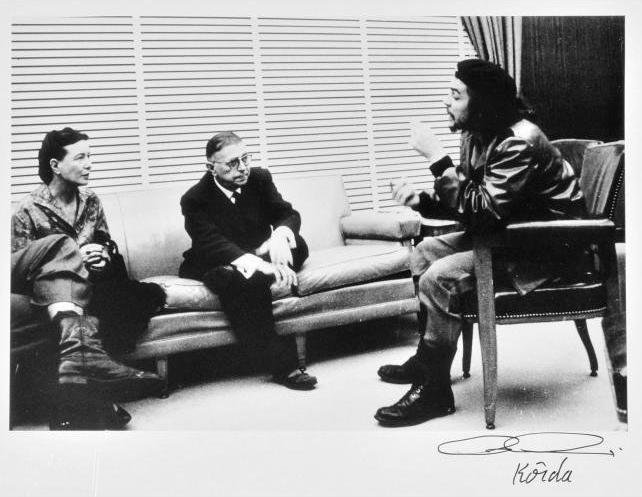
The master-slave dialectic is a lesson about work and oppression; it is also about the necessary experiences of recognition and alterity built into self-consciousness.  The dialectic is between the person who makes a commodity and the person who sells/owns it. No matter how hard you work, if what you have made ultimately belongs to someone else, you are the slave. Concomitantly, the master cannot exist without slaves/workers, and neither has resources or identity without the other.  The recognition of this lesson is a tough one to swallow: we are only ourselves when we are recognized by the other. This, parodoxically, is self-consciousness. Simone de Beauvoir argued that it is unacceptable to see male/female relations as inherently determined by this dichotomy, because gender is permeated by class and the master-slave dialectic is an argument about alienated labor. i am interested in, but don’t know much about, her arguments about gender being a non-dialectical relation; however, i am unwilling to make a resolute distinction between sex and gender, gender and sexuality, or between biological sex and cultural expressions of sex and gender, and understand all to be thoroughly permeated by class, but i think it is fascinating that these roles emerge as erotic possibilities. i doubt that every woman adores a fascist, but for those of us who have, we are happy to serve. We are so good at seeing what is missing, of rising to the challenge. The challenge never ends, because Daddy is never happy. This also means that Daddy never leaves. You do, because you get too tired. Butler: “If wretchedness, agony, and pain are sites or modes of stubbornness, ways of attaching to oneself, negatively articulated modes of reflexivity, then that is because they are given by regulatory regimes as the sites available for attachment, and a subject will attach to pain rather than not attach at all.”

This is a quote from Emerson: “I admire still more than the saw-mill the skill which, on the sea-shore, makes the tides drive the wheels and grind corn, and which thus embraces the assistance of the moon, like a hired band, to grind, and wind, and pump, and saw, and split stone, and roll iron. Now that is the wisdom of a man, in every instance of his labor, to hitch his wagon to a star, and see his chore done by the gods themselves. That is the way we are strong, by borrowing the might of the elements. The forces of steam, gravity, galvanism, light, magnets, wind, fire, serve us day by day, and cost us nothing.” This reads, to me, as a slightly different model.  My last chef would often describe items on the menu as electric, and when diners–shocked by the effect of dishes that appeared to be incredibly simple–even insubstantial–struggled for adjectives to respond to their experience, i would tell them that chef calls it “electric,” and they always seemed delighted by this accuracy. i was always reminded of Whitman, his singing the body electric: “And if the body does not do as much as the Soul? And if the body were not the Soul, what is the Soul?” And Spivak again: “Lorded, and yet, as if not lorded.”

i once had an acupuncture treatment that was about 5 hours long. There were 6, maybe 7 people working on me. i hadn’t been diagnosed with narcolepsy yet, but i knew something had given out, and i was trying to fix it. One of the girls said that my pulses were so low when she first picked up my wrist, that i didn’t seem to be alive. Acupuncture stimulates your energy using needles and an understanding of the body’s blood meridians. Galvanism involves a very different therapeutic application of electricity to the body. It was discovered in the late 1700s when electric surges given to dissected frogs made their legs jump, seeming to bring them back to life. The experiments filled the popular imagination with ideas about the possibility of stirring the dead.  Think Frankenstein. Think shock and its transformational qualities–traumatic and otherwise. Galvanize is now used to describe any stimulation that is the result of (positive) shock–as though it were electric. i think of the surge delivered to my own wrist through the simple surprise of a few sturdy fingers encircling it, or by long warm fingertips pressed against an open palm–although they might have had to press harder than usual to jump my response. i think of a gaze held for 2 or 3 seconds too long, the wakefulness this connection somehow produced in me, my own wagon hitched, for a second, to a star.

Down for you is up

i am beginning to wonder how the narcolepsy works on my already busted sense of time. i mean, if i simply can’t set sleep aside for the proper time, and if this is not an indication of actual exhaustion or engagement, then it must contribute to my inability/refusal to run on schedule. When i warn someone i’ve newly met about it (the episodes are rarely dramatic, but i will zone out and i will probably seem to be awake–i might even be stuffing my face or walking–but i am indeed unconscious; my nervous system is shot, so i shake when i’m angry, etc.), his or her first question is almost always, “When did it start?” i honestly just don’t know. i’ve always liked to nap and fallen asleep at inappropriate times, but i’ve also kept irregular hours for my entire adult life. i stay up late. i wake up early. i nap a lot. i worked too much while i was pregnant. Food turns me into a zombie. Are these symptoms of the narcolepsy, or are they the things that provoked it? i am embarrassingly inept at math. After a full cup of coffee, i often wake up face-down in my book at coffee shops. i’ve woken up many times on the subway with my book on the floor in front of me–notecards sprawled everywhere and my pen rolling down the car. i am always at least 5 minutes late. Lately, in the afternoons, Jonas has been yelling “OPEN!” at me when i start trailing off and my eyelids drop. At night, reading stories to him, i randomly start ad-libbing, and he corrects me every time i make a mistake, snapping me back for a second.  Many nights, i come in late and head straight for the fridge. i wake up a few hours later, a bag of shredded cheese or chips in my hand and my body stretched out like a crime scene on the kitchen floor.

This is all compounded by the fact that i don’t kill time: i practice a serious dedication to nostalgia. When i began my dissertation, i wanted to organize it around a preoccupation with what i called “productive melancholy”–a sort of permanent refusal to mourn or to ‘get on with it’. If heteronormativity is a mournful response to queer possibilities, then what would it mean to not let go of those supposedly unfortunate desires in favor of a succinct timeline? Instead of the one on which everyone graduates on time, never takes incompletes, gets their shit together early enough to have several kids, and always negotiates for the most lucrative job, what other life narratives will do? What would it mean to let go of professional advancement? Is it really for everyone? What gets lost in the turns, when only the family gets reinforced as the ties that matter, and semester after semester of students become so many piles of term papers, co-workers become some kind of Fordist cog, and work is always practically designed to produce the most surplus value? Is there a different economy to the time my body has decided to occupy?

Cathy Caruth suggests that one indication of how time is not simply a repetition of beginning, middle, and end, of signs that signify and mean once and for all, is trauma.  Trauma figures the way an event might not signify in its initial moment of enunciation, but its effects might be legible only much later, and even as legibility becomes possible, progress doesn’t. It happened, it didn’t/couldn’t mean anything/mean yet. Time passes, and meaning becomes not only available, but more aggressive and repetitive. For Caruth, this is also an argument about history–if time flows in multiple directions, then the question of “what happened” is hugely complicated.

As for what happens, is it possible to not be goal-oriented in our feelings–romantic, erotic, intellectual, and otherwise, or is this just another narcoleptic question, straight to REM, no stage one or four of sleep?  Narcoleptics hit the ground running with their dreaming. As soon as they nod off, dreaming begins–often giving them the hallucinatory sensation of reality.  i am protective and impractical of letting go. i “waste” a lot of time on feelings and attachments that will not ever, “Go anywhere.”  Feelings seem just as real as, well, what else is there? Once, before my narcolepsy was diagnosed, my Mom sent me to a medical empath.  i walked into the room and sat down, and she asked me how i was feeling. She asked me to talk about my family, and after a minute or so she said, so who is this guy? Her theory was that there was someone from my past who  i was so attached to, and/or who was so attached to me, that i was allowing it to destroy me physically–they call it being “corded” in the biz. What’s weird is that i hadn’t mentioned any guy.  She gave me her card and told me to call her when i got back to New York if i wanted to commit to shaking him loose. i never called.

We sit together drunk, like our fathers used to be.

The sky was breaking, and I felt a little less numb

than the alcoholic devotedly spooning

pate from a tub; than the divorcee’s station wagon

with its dog-haired sheepskin dogseat;

or the birds barking in the trees to greet the day . . .

“Up in the Air”  — Michael Hofmann

i’m not in the habit of giving poems to people, but yesterday i passed along the same Michael Hofmann poem for the second time in a year. i read an okay amount of poetry–i think i can comfortably say i read more of it than most Americans, (i’m guessing that anyone who’s actually read a whole poem this year can say the same), and his are the ones i carry around.  i’d been up and down Manhattan Avenue twice already. Once to buy water balloons, once for coffee, and now for coffee again as i walked my friend back to the train. We’ve known each other for almost 20 years as adults. We had just left a Memorial Day barbeque. We met working in a restaurant. We were were both ex-cheerleaders and current English majors in the process of “turning” weird. Jonas was soaked in exploded water balloons and basically asleep in my arms and we–both of us (ex?) Floridians–stepped slowly, comfortably warmed by the kind of heat that seems impossible to remember until you’re back trying to move through it, while talking quickly, down Manhattan. She is looking for poems for a project she is in the middle of, and i made a few suggestions before i got to Michael Hofmann.

There is a kind of queerness that doesn’t always wear itself obviously. i am starting to understand that it has something to do with having had a queer childhood. i mean queer both in its current and in its antiquated sense. Children of single parents, of jailbirds, of foreigners, of teenagers, of iconoclastic parents, of families that moved around incessantly, of queers. Of being poor, of being an easy crier, of having had to act like it’s okay to have everything fall apart when you’ve already had a bad day because that same dick at your lunch table made fun of you for being flat. Again. It’s been going on for so long that anyone else would have grown boobs by now. And the absurdity of being bullied for physically looking like a child when you aren’t supposed to anymore while you have had to perform emotional adulthood since long before this jerk had pubic hair is just too difficult to explain. Of being allowed to be quiet and just sit around and read whatever you want, and watch whatever you want, and eat whatever you can find, and listen to what you like over and over, because no one is home. Of having to act like the past-life regression happening upstairs is interesting. Of having had parents switch gender roles, or both perform the same one, or of never having normative models for either. For pretending so hard to be normal that no one would ever guess what your world was “really” like–whatever that means. Some people who are raised loosely fill in those holes as adults, because they finally can. Because they have to know what they missed. Others find being broken-in more familiar, and can’t ever quite adjust to the story of what we are supposed to do at different points along the line–but continue to try. i suppose there are endless variations here, but i am immensely curious about what other people find  comfortable. For some of us comfort actually seems like perversion–picking at the strings is sometimes the only relief.  For others of us regularity feels like a welcome challenge.

i don’t know much about Michael Hofmann’s childhood, other than what is suggested by his Dad’s book, Luck, but i have spent some time with his poems, many of which are either about his father or about fucking. There is a queerness to them that seems to me apiece of what i am describing here. The willful risk for the erotic. The unwillingness to designate the poems as a place where any juxtaposition might be too much. A way of existing i find attractive even though i was raised to understand it as repulsive. The complications of nature and the inescapable weather. Mexico. Men. Music. Dad. Drugs. Kids. Cheating. Hart Crane. Starting again. Lynyrd Skynyrd.  Drinking. Class. The biting observations of a stranger as he becomes a familiar. Silencing word choice. The South. Europe. Gainesville. London.

Beer drunk, sitting across from him one night at the Salty Dog Saloon in Gainesville, i said something about not being able to fathom having had a famous novelist as a father, (as he had), or of being the child of someone who did similar work to my own, when my own father is an electrician who spent most of his working life climbing poles. Your job as an academic is not so different, he said. Plugging things into holes.

This is the poem i recommended to my friend, who is interested in hotel rooms.  It is from Corona, Corona (1993):

“Schonlaternengasse”

Better never than late like the modern concrete
firetrap firegaps spacing the Austrian baroque, risi pisi;
like the morgenstern lamp’s flex leaking plastic links of gold,
leaving the cutglass nightlight good enough to drink;
like the same tulip reproduction twice in our hapless room,
where the twelve lines of a spider plant die without offshoot:
your period, which we both half-hoped wouldn’t come.

Here is another, from Poetry (June 2008):

“For Adam”

In that aftertime
I wasn’t writing. I never wrote,
I didn’t know what the aftertime was for.
I felt little, collected nothing.
I talked to myself, but it was boring.


Beneath the paving stones

“Longing produces modes of both belonging and “being long,” or persisting over time.  Yet, this is more than desire, for desire is a form of belief in the referential object that the subject feels s/he lacks and that would make him or her whole (and insofar as this referential object is often posited in terms of a lost object, desire is ‘historiographical,’ a way of writing that object into the present).  Erotics, on the other hand, traffics less in belief than in encounter, less in damaged wholes than in intersections of body parts, less in loss than in novel possibility….”

–Elizabeth Freeman, Time Binds

A little while ago, i was very lucky to attend a panel discussion of Gayatri Spivak’s massively influential essay “Can the Subaltern Speak?” at CUNY’s Center for the Humanities.  Spivak has often described her critical and pedagogical work as a task of, “re-arranging desires.” She uses the one-liner, “Plain prose cheats” as a counter-argument to charges that her prose is too difficult to follow. A major text of deconstruction, Derrida’s Of Grammatology, found its way into English through her translation, and it was her choice to use the word trace–an outline, a track, a remnant, a footprint, a spore–as a way of marking a number of concepts from Derrida that can’t be fixed with a single word: “…Derrida suggests that what opens the possibility of thought is not merely the question of being, but also the never-annulled difference from ‘the completely other’.  Such is the strange ‘being’ of the sign: half of it always ‘not there’ and the other half always ‘not that’. The structure of the sign is determined by the trace or track of that other which is forever absent” (Spivak’s “Translator’s Preface”).

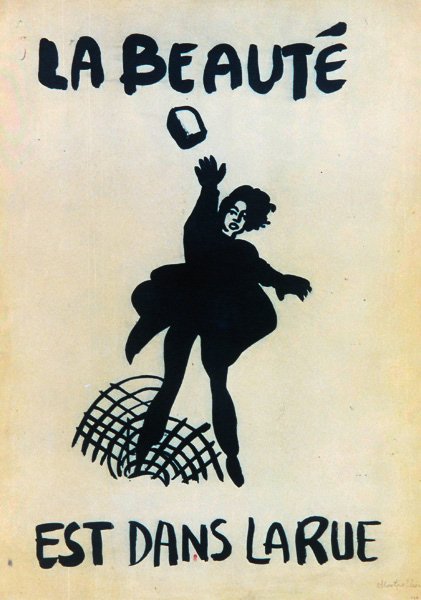
Plain prose cheats.  i came across this puzzle early in grad school, and it seemed infinitely more honest to me than some of the other slogans my fellow budding Marxists were latching onto. Sous les pavés, la plage (beneath the paving stones, the beach), for instance, seemed well-intentioned, but naive.  The fantasy of a pastoral return to some kind of harnessed true nature just didn’t quite persuade me. i think the High Line park in Manhattan is a more viable model.

i found that other great Situationist axiom, La beauté est dans la rue (the beauty is in the street), to be more appealing. My boyfriend at the time had a crinkly photocopy of the image of the girl in the street throwing a brick taped to his wall, and for years it was the first thing i saw when i opened my eyes in the morning.  Ah, Gainesville. The Gainesville where you didn’t have to begin at the beginning every single time to have these conversations because it was ongoing, i miss you. My first tattoo (i only have three) was of the Japanese term for ‘trace’ inside my left wrist. i was still studying Japanese at the time, and thinking a lot about translation, and the kanji for trace was on the cover of a book i was reading.  Now i look like just another girl with a Chinese symbol on her body that maybe means fate, maybe destiny, she can’t remember and can’t read it. Pretty cheezy, i know, but i would never have it removed.  i treasure it as the mark of that initial passion i had for theory and academia.

Plain prose cheats.  Here is Spivak: “[W]hen I’m pushed these days with the old criticism – ‘Oh! Spivak is too hard to understand!’ – I laugh, and I say okay. I will give you, just for your sake, a monosyllabic sentence, and you’ll see that you can’t rest with it. My monosyllabic sentence is: We know plain prose cheats.” When i saw Spivak, the event reminded me of why this phrase strikes me as such a necessary warning. i would stay on auto-pilot for at least another year after seeing her, but, very slowly, i began to shift gears. Judith Butler was on the panel, and each speaker gave a brief, engaging description of how Spivak’s essay had formed her or his work.  i had almost not gone. Jonas was sick and i had to take him, coughing, to the sitter, if i wanted to go.  With a heart heavy with mother-guilt, i went.  When Spivak spoke, she told this story. This is a very long quote, forgive me:

“My grandmother, Raseswari Debi, had two sisters – Saileswari and Bhubaneshwari. The youngest one killed herself at 17. It is her story I tell in “Can the Subaltern Speak?” In order to show, that whereas the British Indian reform of sati is much celebrated, when a young, single girl attempted to write resistance in her very body, she could not be read.

If only I could occupy with desire, that singular inscribed body. I have tried to understand how she felt as she waited for her periods to begin, so she could disprove what she knew would be the conclusion drawn from her hanged body – illicit pregnancy.

My modest reputation rests on two items – the introduction to Derrida and the commentary on Bhubaneswari Bhaduri’s suicide. I am following that track, still. Why did I not mention my relationship to her, when I wrote of her? I wanted to see what would happen if she didn’t have that certificate of authenticity which would reflect more on the people’s approval of me, than on her.

In my reading this morning, I cannot tell how it was she who opened up for me that line from the Mahabharata – a description of Queen Draupadi, dressed in her single cloth, stained with menstrual blood, dragged into the royal court. But I can say that it is perhaps from this single woman, a girl of 17 who engendered my intellectual trajectory, that I get my sense of singularity.

I repeat in difference, these singular women who are mothers in many different ways, who teach me that reproductive heteronormativity is simply one case among many – like a stopped clock giving the correct time twice a day, rather than a norm that we persistently legitimize by reversal.

The entire epic of the Mahabharata is about this insult to Queen Draupadi, who had five husbands. And in the beginning of the Mahabharata, because it was an oral formulaic epic and each bard had to know the whole story – the entire story is given in the form of a young boy telling it to the blind king.

And in that story, again and again, we hear that all of this disaster happened because a woman was brought into public while she was menstruating; while she was in her feminine nature – stridharma.

She was a queen. The queens, when they menstruated, were taken to a lower chamber and they wore only one piece of cloth until the menstruation was over; then they took their bath – healing bath, I suppose – because they were unclean.

That’s the whole story behind Bhubanehswari also, that I’m asking you to remember. She used this menstrual blood as a way to inscribe her message and was not heard. But anyway, when the five husbands in the epic are playing dice in the main court – they keep losing and finally they wager her.

And so, when they wagered her and they lost, she was dragged up from that chamber downstairs. So the queen comes into the open court wearing nothing but that one white cloth, smeared with menstrual blood. This is the thing that led to the fight.

Now, as to how a feminist reads this, that’s something else. This is not a presentation of a feminist reading of the Mahabharata, but I’m just saying that because my grandmother’s sister dragged herself into the open court of death menstruating, only earned me opprobrium from people who read quickly, and said – Spivak refuses voice to subaltern resistance.

And I see women every day saying – the subaltern is speaking because I am, and so on. And I say to myself – my mother was wrong. She had said – you are using her name? I had said – ma, no one will pay any attention to her. And I was right.

So the queen is dragged up. She asks the oldest member of the court, who also has a marriage story – am I a piece of property that can be wagered? And the oldest member of the court, Bhishma, is not able to answer her.

This is not a bit from the Mahabharata that’s given much popularity. If you have seen Peter Brooks’ version, you certainly have not noticed this. But there are female versions of the epics, StriMahabharata, which are very different and in the best-known of them, the entire epic ends, not with the brothers climbing the hill to heaven, but Draupadi laughing in the devastated field of war, somewhere in the empty camps. Draupadi’s laughter ends the women’s epic.

Now, the bard describes Draupadi as nathavati anathavat. Generally, this is translated as – someone with husbands, as if an orphan. Natha actually means lord. I translate it differently. And as I said, I am the object of opprobrium from the traditionalists and the racists and the horrible guys, as well as the resenters of theory, the activists; as well as the folks who are in the traditional camp, faulted for being too European.

Nathavati anathavat: Lorded, and yet, as if not lorded. In my reading, each time the woman menstruates, lording has misfired in the suspension of reproductive heteronormativity. And I believe that’s why, again and again and again, in the opening conversation that is the entire story, what is told is – she is in her feminine nature, in herstridharma, suspended.

A suicide at age 17, and a disgrace in the family, made me understand how the message in the ancient text was transactional. She became my allegory of reading of a powerful woman-moment in my past. And in fact, that way of reading is what allows us to be responsible to our students. I hope I have not been too theoretical for you, but I gave you my alibis before I began.”

Really, you should read “Can the Subaltern Speak?” to fully grasp this story, but i hope this anecdote also works on its own.

Future starts slow


The last time i flew, i blacked out during the plane’s slow descent into Dallas. i don’t have any anxiety that i’m aware of about flying, and it’s never happened before.  i was hungover, but i always am when i fly. i’d been out in the sun the day before, and when it started coming on, i thought i was just feeling the heat on my skin from the first hour i’d spent by a pool, just sitting there, in years.  i’ve passed out enough to know what was happening. i was hot–seconds before i’d been freezing. i took off my jacket and my bare arms were covered in cold sweat. i kicked off my shoes and just kept telling myself to breathe. Slowly my vision went tingly and began to fade. Everything within my line of vision kept breaking until i felt like i was staring at a television turned to a channel that had just gone off the air–back when television stations still went off the air and i still watched TV.  Narcolepsy has trained me how to be ready to have consciousness taken away from me, so i just closed my eyes and waited as my body took over for a minute. i was out.  i was back. Waves of nausea crept in, but thankfully my vision  quickly returned.  By the time the plane was on the ground, i mostly felt okay. i grabbed a peanut butter chip cookie and a Caesar as i passed the food court. i splashed water on my face in the bathroom.  i just made my connecting flight.

i’d packed meticulously for a visit i’d recklessly undertaken.  i carried one big black canvas bag and a tiny black leather purse.  i’d gone to Muji and purchased little containers for the liquids. My new bikini was tucked into a side pocket and my new little black dress was folded around a black satin slip. Overdetermined by absence and difficult to read, the visit was not designed to provide answers or hope. It had just been necessary, and it was already over, and i was barreling back to New York and work and a life i had just started learning how to love. Almost no one knew i had gone, or where, or why.  Packing–collecting everything i would need, imagining the scenarios in which different articles would be worn and removed, had given the whole thing structure, but now that those days had passed i knew that if i unbuckled my seat belt i might disappear. Nothing would change because of the trip, but something was certainly different.

For two completely unrelated projects, i was re-reading Fredric Jameson’s Postmodernism. When i’d left New York, as i was slowly making my way through first class into coach, a handsome, extremely vital man seated in the first row got excited when he saw it tucked under my arm. “That’s a great book,” he assured me. “You don’t see it much anymore. It’s fantastic to see it.” Yes, i know, i replied. i am very familiar with it. He asked if i was an academic and i said something like, why else would i be carrying this right now? “Well, there are those of us who have an avocational interest in it,” he explained. i gave him my, “How nice,” grimace and kept shuffling along, but i had appreciated his excitement. Anyhow, here is the passage i am fixated on now:

“There is, for one thing, a most interesting convergence between the empirical problems studied by Lynch in terms of city space and the great Althusserian (and Lacanian) redefinition of ideology as ‘the representation of the subject’s Imaginary relationship to his or her Real conditions of existence’.  Surely this is exactly what the cognitive map is called upon to do in the narrower framework of daily life in the physical city: to enable a situational representation on the part of the individual subject to that vaster and properly unrepresentable totality which is the ensemble of society’s structures as a whole” (51).

See, i’m not entirely convinced that i could ever claim to really know where my real conditions end and where the imaginary ones pick up, especially when my conscience seems to be so delicately wired into my capabilities for consciousness. Nonetheless, these places and times where my body reminds me of my lack of complete control might be the closest i will ever get to honesty, and i am happy for them.

We can’t afford to look this cheap

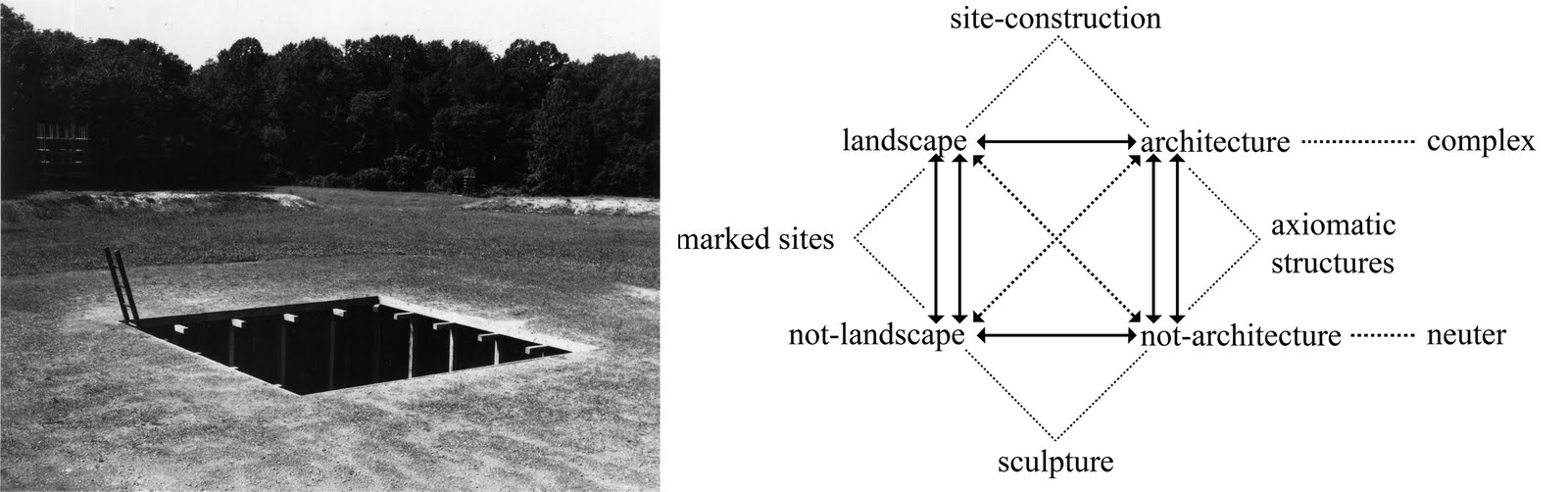
“We had thought to use a universal category to authenticate a group of particulars, but the category has now been forced to cover such a heterogeneity that it is, itself, in danger of collapsing. And so we stare at the pit in the earth and think we both do and don’t know what sculpture is.” –Rosalind Krauss “Sculpture in the Expanded Field”

I forced something I’d written on a friend the other day. He got halfway through the introduction and asked about my suggestion that the poet I was writing about uses science as a metaphor.  The text reads: “Girmay looks closer at biological descent and adaptation as metaphors for survival and creation…”  In my introduction, I meant that she uses these ideas as metaphors, not that she writes about their definitional status as metaphors, although I wouldn’t necessarily disagree with that statement, either.  Nonetheless, i immediately got an excited grin on my face. i like this question–a lot. It is not unlike one of the major preoccupations of queer theory: what happens to the original when you begin making metaphors out of it?  If language itself is an arbitrary set of conventions, not rooted in nature but historically solidified and mutable at the same time, then how does this complicate the possibility of designating any narrative as the primary or, original, one? If science and “nature” cannot exist outside of our ability to describe them, then how do we understand how the process of description also forms any object of analysis?

Judith Butler’s essay “Imitation and Gender Insubordination” contains one of my favorite rehearsals of this debate.  She explains that a common criticism of queer identity is that it is a poor copy of the original.  Butch lesbians are a poor copy of real men, the gay falsetto is a cloying grasp at natural feminine behavior, etc.  Butler made the suggestion that the gays aren’t the only ones performing.  In fact, there is possibly something really gay about heterosexuality.  What leads a girl to learn how to be the mirror image of her mother or her best friend? What is hyper-masculinity, the type that requires dedication—visits to the gym every day, lots of male bonding, a particular vernacular, a very specific set of sexual object choices, meant to represent? If it requires so much practice, why do we call it natural? Because it just feels right? Then what about all of those men who find it uncomfortable at best, women who find cliché representations of femininity laughable, or lesbians who feel very comfortable wearing lipstick and being high femmes? How do these contradictions fit into the nature/gender/sex rubric? Butler calls it a matrix. She goes on to suggest that what we have historically called gender is actually sex–both the kind that you “have” and the kind that you “are.”

What does that mean? It proposes the possibility that when we teach little girls to prefer pink and everything else that is supposed to be the opposite of blue, we are also teaching sexual object choice.  This doesn’t necessarily mean that our desires are taught. It suggests that our understanding of our desires as normal or queer is taught, and we are taught to understand coordinations of gender and sexuality through stories about nature.  Commercials are just as good at it as are fairy tales, and while they should supposedly be protected from sexualized narratives, we pretend that the extreme gender coaching that happens in the stories they are “ready” for are not also about sex. If accurately gendered behavior involves appropriate gender of future sexual object choice, then teaching gender actually does teach sexuality.

So, what is metaphor, and what is its role in this discussion? If a metaphor is a figure of speech that describes something through the characteristics it shares with something else, must one term in the analogy be the original? Allegory and simile are, of course, other keys terms in this conversation.  The first footnote in Butler’s Psychic Life of Power (1997) gives a very useful history of metaphor in Western thought, alerting readers to the role metaphor will play in her book.  She talks about the practice of using the turn as a figure for the way a metaphor works, and for this book, she is concerned with how subjection—our assent to and manipulation of power—works through a turn against the self. We gain access to power by accepting its rules. We make this choice and we don’t. If we believe in the subconscious, we believe that we are not always in complete control of the decisions we make. Not exactly.

The fact that something or someone is real—it happened, he really did exist—doesn’t keep it or him from being a metaphor. It’s open. That’s why this question makes me grin.

Perfect Teeth

i recently had the luck of interviewing poet, teacher, connoisseur of abandonment, and lovely badass Aracelis Girmay for the Brooklyn Rail.  We fell very easily into conversation about her newest book-length collection of poems, Kingdom Animalia (2011), which was nominated for a National Book Critics Circle award this year. Here is the result:

http://www.brooklynrail.org/2012/05/books/aracelis-girmay-with-melinda-cardozo-aracelis-girmay-kingdom-animalia-boa-editions-2011

I Like Fucking

“We would walk into environments that were very straight white male dominated and felt very unwelcoming to anybody that wasn’t a straight white male and we would say we want to transform this space and we want to make this a space where women feel not only welcome but that they can enjoy themselves–which was a radical concept actually in the underground punk scene in the ’90s.”

–Kathleen Hanna

i went to grad school in order to think about what pleasure and desire have to do with each other. i knew this was ultimately what i wanted to write about, but i needed to read more. i wanted to figure out my place in the argument, and learn how to give my work a shape that understood itself. i was interested in how and why both desire and pleasure can be so incredibly disruptive.  Do other people’s bodies teach us something that, say, talking, doesn’t? What do we lose when we stop attending to libidinal desires, often in order to execute more normative, generally financial, comfort-based ones?  How/does sex hurt–not only in cases of violence, but perhaps when it violates ideas of trust and ownership? How can one build an academic career that, by its very definition involves the study of literature, on an interest in sex? How can reading be doing? How can doing be reading? Thank you Feminism, thank you Karl Marx, thank you Audre Lorde, queer theory, Goerings Book Store, Amitava Kumar, Kathleen Hanna, Judith Butler, poetry, teaching, Foucault, ACT UP, Judy Chicago, Riot grrl, Community Action Center, Wild Iris Books, Nishant Shahani, David Wojnarowicz, and Deconstruction for showing me a world in which these questions are valued and possible.

Then there are my ingredients: memories that haunt me–the things, often guilty pleasures, that made me obsessive and desiring in the first place. Osaka, the Baader-Meinhof Gang, Gone With the Wind, drugs, libraries, flea markets, house parties, house fires, thrifting, love hotels, passing notes, the Rolling Stones, Barthes, kabuki, my parents’ wedding album, Morrissey, professor-love, the pool, drinks after work, Stevie Nicks, marriage, restaurant jobs, floating down the Ichetucknee in an inner tube, Denis Johnson, and lots of problematic, fun, shit-stirring, sweet, unadvisable, dirty, necessary sex.

So far i have failed in my efforts to make these worlds coincide. The things i live by in one sphere often can’t stand what i can’t live without in the other one. i spend years investing in one side, then drop out for a while and give the other one everything i have.  A gesture or a vocabulary word that is de rigueur on heads is met with eye roles or blank stares by tails.  i don’t need, or even want, to be in Gainesville–or the 90s–anymore, but i sure am happy they both happened to me and gave me a peek at how the coexistence of these concerns might actually unfold. The non-dualism of queer theoretical work and the suggestion that sex is gender, teaching and writing, the possibility of rethinking community–these are the hopes that remain.

Spinning glue back into horses

“We would have known nothing of the nature and reach of her sorrow if she had come back” (Housekeeping 198).

In typical Cardozo fashion, my Dad never finished the barn he began building for the tiny farm my parents fumbled with as part of the general toil of my early childhood.  Along with the rest of the future rednecks taking part in the late Seventies/early Eighties white flight exodus from Miami to pastoral exile, by the time i was three my relatively cosmopolitan parents had gone country. They began building the barn before my Mom left, which would make her claim, many years later, after she had relocated to the Russian River Valley in Northern California, that she wanted to make a photo book of all of the gorgeous, dilapidated farms in that area that much more bittersweet.  Of course, she never bought a camera.

Along with the chicken coop covered in Japanese honeysuckle, the hand-painted mailbox marking our spot on a dirt road, the brick house, the creek, the gardenia and azalea bushes, the subscription to Mother Earth News, a huge tractor, a pig, a magnificent garden complete with pea trellises and sunflowers, my Dad’s light blue Chevy pickup truck, and my Mom’s cherry red Fiat Spider, we had the beginnings of a barn.  My Dad had never built anything like this, but he could’ve pulled it off.  Papa, my grandpa who had been a brick layer in Miami for his whole working life, would come over to help, and i remember the two of them drinking beer and planting huge wooden poles that would become the foundational pillars for the barn.

It had a tin roof, perhaps for my Mother, who ‘loved the sound of rain tapping against a tin roof’.  After she had left, wanting to know something about what exactly it was that  she did love, at the first sign of rain i would fly through the back yard, out to the ‘back two and a half’ (acres), and up the staircase to the second floor of the barn. There were no walls yet, nor would there ever be anything of the sort.  i’d stretch out on the rough wooden planks of the floor, close my eyes, start listening hard to the rain, and wait. i wanted to hear what she heard, but the kamikaze splatters unnerved me.  i didn’t find it soothing, or beautiful. i figured i wasn’t trying hard enough.

In the earlier days, there was a pig named Ms. Piggy, piglets, two adult Golden Retrievers (Harmony and Moonshine), several litters of puppies, 2 cats (Shanti and Tigger), a rabbit (Bunny),  hamsters (Bernard and Bianca), a cockatiel (Professor), and three cows (Petunia, Judge, and Joker).  Unlike another little girl with whose story i was very familiar, i would not be able to save our pig from the slaughter (or the cows). In fact, i would come home from school one day to find Petunia strung up in one of the huge pines in the back yard, skinned beyond recognition, her brain in the kitchen sink.  i was given multiple talks about economy and nature and about this just being what people have to do.

At some point, while watching a particularly harrowing movie, my Dad told me, “It’s a Hollywood movie. There’s no way they’re going to kill the hero.” i loved the tidiness of this information, and took it to heart. The rub was finding out that real life did not play by this rule. Ms. Piggy wound up in the skillet and Petunia flavored countless batches of chili. My Mom left. The house fell apart. Grass grew over the tractor’s wheels. The barn remained our own private A-bomb Dome–a skeletal reminder of what’d happened before we were broken. And i rehearsed that it was all character-building and eccentric and fine, but lately i’m not entirely convinced.