
“The unpampered ear does more. Once when I was in Michigan for a term, and didn’t have a record player, someone in Shaman Drum put on Lloyd Cole and the Commotions, and I had to stay there browsing unobtrusively for the next forty minutes, feeling like a pervert. That’s music starved, that’s not bad repro.”
–Michael Hofmann, Paris Review
Last Tuesday, mid-day, I was walking down and around 5th Avenue and 12th Street with a cardboard box full of LED Christmas lights and golden, glittery, spray-painted pine cones. I was mid-job. We were decorating a semi-famous actress’s apartment for her holiday party. On my way back from retrieving a few extra things from the parking garage, rain began to fall. My arms were full and I couldn’t reach for my umbrella, so I sidled up between a few strangers with more coverage than they really needed and fell into step with a couple of them as the light changed.
Two men directly behind me, one vaguely professorial and the other eager and overly agreeable in that grad student sort of way, both probably attached to the New School which was right up the street, were talking shop. My ears perked up at a few derisive comments about multiple dissertations “on” Alvin Toffler’s Future Shock. I moved closer as the professorial one cited Ben Lerner’s new novel, 10:04, as a positive example of something the dissertations were missing. He referred to the review of 10:04 in Bookforum that he’d just read?written? (I wasn’t close enough to hear) in order to make an argument about the argument Lerner was making about the future. I had the novel in my tote bag. I’d been dragging out the last few pages, not wanting to finish, for the last week. I opened my mouth to argue with him about his characterization of the novel, and then I looked into my box and remembered where I was and who I seemed to be: some sort of local crafter, wet in the rain, somehow implicated by this box of decorative objects. I realized I didn’t know these people and would probably seem a little nuts if I did interject and, as for the immediate future, I had completely forgotten to buy suction cups with little hooks on them to attach the actress’s wreath to a large mirror in a subtle but sturdy way.
When I was an undergrad, my favorite professor’s most controversial pedagogical strategy was to keep the false binary between public and private under erasure at all times in his dealings with us. In a class called “Black Britain” there were 2 people who were Black in the American way. One of them was always late. My professor, who was Black in the British way, unsuccessfully tried to provoke this student into punctuality by reminding him that “Hey motherfucker,” classes at the University of Florida did not run on “colored time.” One night at a bar he met my handsome blue-eyed boyfriend, and the next time I saw him he said,”I guess that makes your life easier when you go home for Thanksgiving.” The classes were terrifying and electric. For better or worse, he incited more future academics than anyone I’ve ever studied with. I think he might be responsible for that Gainesville flow that probably still pops up at academic conferences: aggressive, funny, and, most of all, in that late-90’s critical theory way, provocative. The aforementioned binary was under erasure in order to disabuse us of our understandings of desire as something that occurs, “in a vacuum.” I can’t speak for everyone, but I am certain that he permanently transformed my understanding of and relationship to want. I began to understand desire as always already embroiled in relations of economy. 
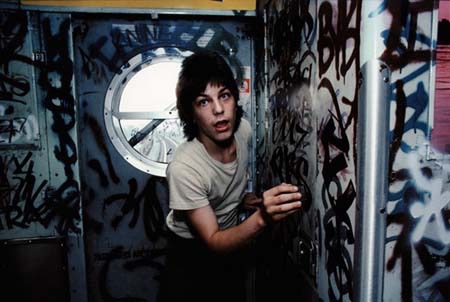
I don’t know about other cities, but there is something that happens every once in a while on the subway in New York when one train passes another. Their coming together feels magnetic as the cars swoosh into a brief clickety-clack rhythm like the sound of a “real” camera. Every time for me it is diamond dust. It is a reel of actual film spooled out me-sized in some sort of Purple Rose of Cairo meets Andy Warhol New York minute. I spy on the passengers in this doppelgänging car and feel the lines between window and mirror blur–momentarily happy again for this city’s enchantments. Always cinematic. Always already a repetition of what I saw or read of this place before I moved here. A future shock where the fact that everything is always already translation does not dilute experience.
When I was in grad school, because utopia–that elusive bastard–was still nowhere, and because we wanted to join the ranks of those who are clever enough to get paid to at least try to save the world, we made critical theory the action of trying to find the places where the ideas we most valued in theoretical texts were made possible in fiction. In 10:04, almost every time Ben Lerner launches into a new anecdote, I feel myself rolling my eyes back into my head just as I would have in grad school when some insufferable classmate felt the need to go on at length about his or her misunderstanding of that week’s text. Instead, I catch myself riveted, eyes wide, as he rips into an example that illustrates his complete comprehension–not only of a concept but also of how to illustrate the concept. Not in reference to so and so’s novel or short story, but through his own writing. I’m not convinced that that is actually a difference that matters, but I am quite sure that the novel “matters” very much. This is darstellung of the sort I had always tried to find. In it, reification, once a death trap, becomes a beautiful, funny source of endless potential.

 noVacancy