“Real things in the darkness seem no realer than dreams.”–Genji Monogatari
On my 20th birthday, i got engaged. My boyfriend was 6 years older than me, and we had been dating for a little more than 2 years–living together for one. There was a picnic, and a diamond, and then later, a wedding. No one was surprised–except my mother, who hadn’t yet caught on to the fact that the organizing principle of my young adulthood was simply (cheerleader in high school, 4.0 in college, borderline anorexic, part of a couple) to not become her.
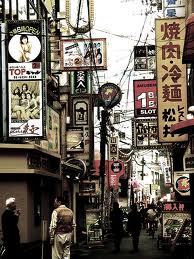
Very soon after we were married, my husband and i moved to Japan. i was studying Japanese for my undergrad, and my school had a (seemingly) very affordable study abroad program. It was designed, of course, for young, single students. Most students lived with a Japanese host family, but there was also a small dorm on campus, and everyone who didn’t have a host family stayed there. Everyone, of course, except me. We had gone early and rented an apartment. He got a job teaching English and i had a sizeable stipend from the Japanese government. My hour and a half commute to school–each way–was standard salariman. From our apartment, i walked for about 20 minutes through a part of Osaka called Kyobashi, past crappy bars and tons of love hotels to get to the Keihan line, which ran between Osaka and Kyoto. My school was basically right in the middle between the two cities, but another 20 minute walk or 10 minute bus ride from the train stop. We would find out much later that Kyobashi was basically Osaka’s skid row, but we never had any trouble.

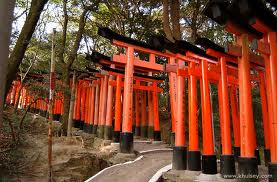
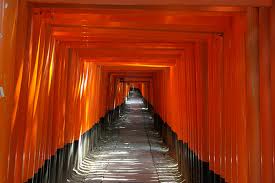
i studied my notecards while i walked. Memorized vocabulary on the train. We barely had enough money to eat, so we chose whatever would give us the most calories for our yen at the grocery store: sticky white rice with peas, puffy white bread for toast in the morning, daigaku potatoes (deep-fried, candied sweet potatoes), and anman (white, warm sticky buns with sweet adzuki bean paste inside) from the 7-11. Impossibly, we got skinnier. Osaka was shockingly hot, and humid. His job was miserable and we never saw each other. Gradually i stopped studying on the train and began looking outside instead, committing to memory the way the city turned into houses turned into green turned back into houses back into city. i went to Fushimi Inari on a school fieldtrip: a temple dedicated to Inari–god of rice and business, guarded by hundreds of fox sculptures and lined with thousands of torii.
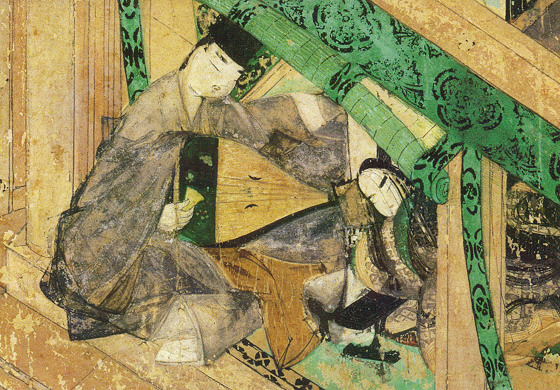
Order melted into disorder became another order. i studied as much, if not more, than ever, but there were no bogus electives like ‘Geography of World Economies’ or ‘A History of Non-Western Art’ to distract me. Just Japanese, but vocab became paragraphs became newspapers. i took a class on Murasaki Shikibu’s very long, very romantic, absurdly beautiful 11th Century novel Genji Monogatari (the Tale of Genji). We read the entire thing. i bought a tiny portable cd player in denden-town and walked and walked.
My grammar teacher and i often found ourselves waiting for the same bus in the morning. We got in the habit of falling to the back of the line to smoke cigarettes and finish our coffee. He’d recently completed his PhD and returned to Japan from a long hiatus in an exotic country studying a dead language, and this was his first year at the University. He was originally from Tokyo. i gave up trying to understand this with my halting Japanese and we began again in English–cracking jokes about our class, talking about where we’d come from, admitting to our new marriages, and arguing about whether Genji was cheezy or not. In class, i would force myself to track the light in the bamboo groves just outside the window, because there was something about the way he held the chalk, and how quickly he moved, and how i jumped when he called on me–“Mindy-san?”–that was unravelling me in a way i had no intention of really, actually letting happen.
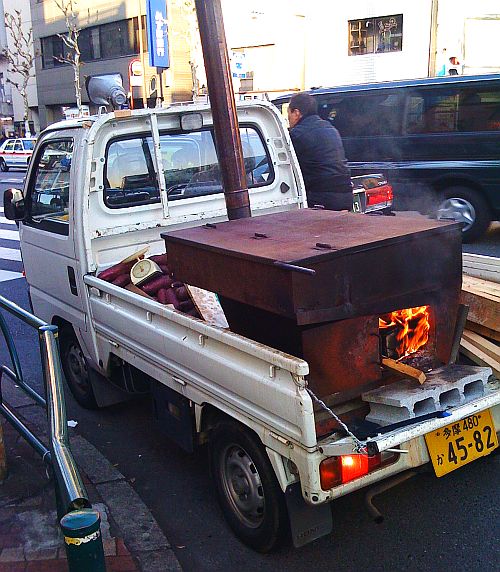
 In 1950, my grandfather, who had survived WW2, found himself testing a wooden plane off the coast of San Diego. The plane went down. He was survived by my grandmother, my mother, and her little sister. A few months later, my grandmother boarded a freighter with her young children and sailed to Japan to serve as a missionary, so, there’s that. She told me the stories she remembered over and over. My Mom did the same. i felt like i kind of had to get there, but i had always imagined myself as a studied observer, not so much as a participant. Now, i wanted complete immersion. October came to Japan and mornings and afternoons–suddenly lit by ruby and garnet and tangerine maple leaves, seemed like the middle of the night to me. i read, in the Genji: “Autumn is no time to lay alone.” Anorexia was chased off by eel and ramen and sake and sweet potato venders driving their tiny trucks down backstreets yelling, “YAKI-IMO!!!”
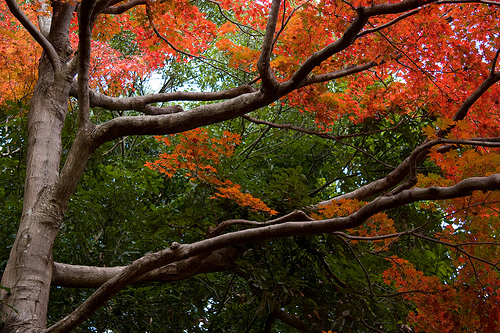
The bus gave way to momiji (maple leaf) viewings–just sitting outside at temples, drinking beer and staring at autumn all lit by stone lanterns. Temples gave way to sushi bars and eel restaurants and sitting on the edge of the Kamo River knowing what came next and enjoying those last minutes of pretending that it didn’t.
 noVacancy