
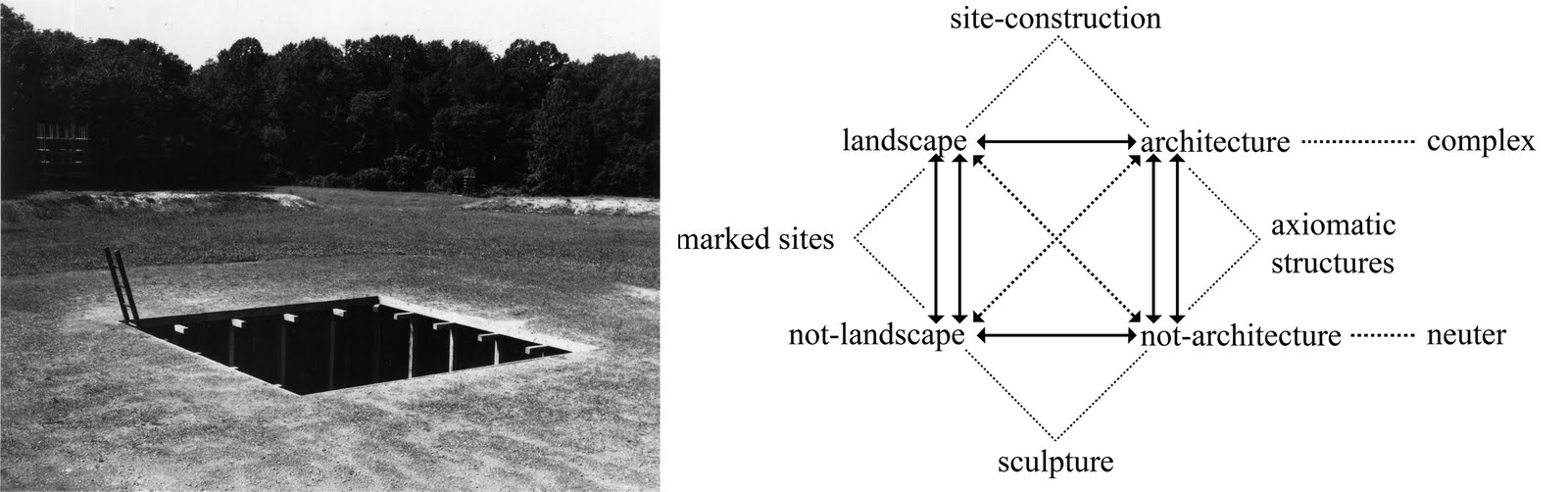
 “We had thought to use a universal category to authenticate a group of particulars, but the category has now been forced to cover such a heterogeneity that it is, itself, in danger of collapsing. And so we stare at the pit in the earth and think we both do and don’t know what sculpture is.” –Rosalind Krauss “Sculpture in the Expanded Field”
I forced something I’d written on a friend the other day. He got halfway through the introduction and asked about my suggestion that the poet I was writing about uses science as a metaphor. The text reads: “Girmay looks closer at biological descent and adaptation as metaphors for survival and creation…” In my introduction, I meant that she uses these ideas as metaphors, not that she writes about their definitional status as metaphors, although I wouldn’t necessarily disagree with that statement, either. Nonetheless, i immediately got an excited grin on my face. i like this question–a lot. It is not unlike one of the major preoccupations of queer theory: what happens to the original when you begin making metaphors out of it? If language itself is an arbitrary set of conventions, not rooted in nature but historically solidified and mutable at the same time, then how does this complicate the possibility of designating any narrative as the primary or, original, one? If science and “nature” cannot exist outside of our ability to describe them, then how do we understand how the process of description also forms any object of analysis?
Judith Butler’s essay “Imitation and Gender Insubordination” contains one of my favorite rehearsals of this debate. She explains that a common criticism of queer identity is that it is a poor copy of the original. Butch lesbians are a poor copy of real men, the gay falsetto is a cloying grasp at natural feminine behavior, etc. Butler made the suggestion that the gays aren’t the only ones performing. In fact, there is possibly something really gay about heterosexuality. What leads a girl to learn how to be the mirror image of her mother or her best friend? What is hyper-masculinity, the type that requires dedication—visits to the gym every day, lots of male bonding, a particular vernacular, a very specific set of sexual object choices, meant to represent? If it requires so much practice, why do we call it natural? Because it just feels right? Then what about all of those men who find it uncomfortable at best, women who find cliché representations of femininity laughable, or lesbians who feel very comfortable wearing lipstick and being high femmes? How do these contradictions fit into the nature/gender/sex rubric? Butler calls it a matrix. She goes on to suggest that what we have historically called gender is actually sex–both the kind that you “have” and the kind that you “are.”
What does that mean? It proposes the possibility that when we teach little girls to prefer pink and everything else that is supposed to be the opposite of blue, we are also teaching sexual object choice. This doesn’t necessarily mean that our desires are taught. It suggests that our understanding of our desires as normal or queer is taught, and we are taught to understand coordinations of gender and sexuality through stories about nature. Commercials are just as good at it as are fairy tales, and while they should supposedly be protected from sexualized narratives, we pretend that the extreme gender coaching that happens in the stories they are “ready” for are not also about sex. If accurately gendered behavior involves appropriate gender of future sexual object choice, then teaching gender actually does teach sexuality.
So, what is metaphor, and what is its role in this discussion? If a metaphor is a figure of speech that describes something through the characteristics it shares with something else, must one term in the analogy be the original? Allegory and simile are, of course, other keys terms in this conversation. The first footnote in Butler’s Psychic Life of Power (1997) gives a very useful history of metaphor in Western thought, alerting readers to the role metaphor will play in her book. She talks about the practice of using the turn as a figure for the way a metaphor works, and for this book, she is concerned with how subjection—our assent to and manipulation of power—works through a turn against the self. We gain access to power by accepting its rules. We make this choice and we don’t. If we believe in the subconscious, we believe that we are not always in complete control of the decisions we make. Not exactly.
The fact that something or someone is real—it happened, he really did exist—doesn’t keep it or him from being a metaphor. It’s open. That’s why this question makes me grin.
 noVacancy